Where Mountain Meets Desert: Exploring the Ancient Cultures of Morocco’s Amazigh and Arab Peoples
By Kwadwo Afrifa – November 19, 2025 13:00
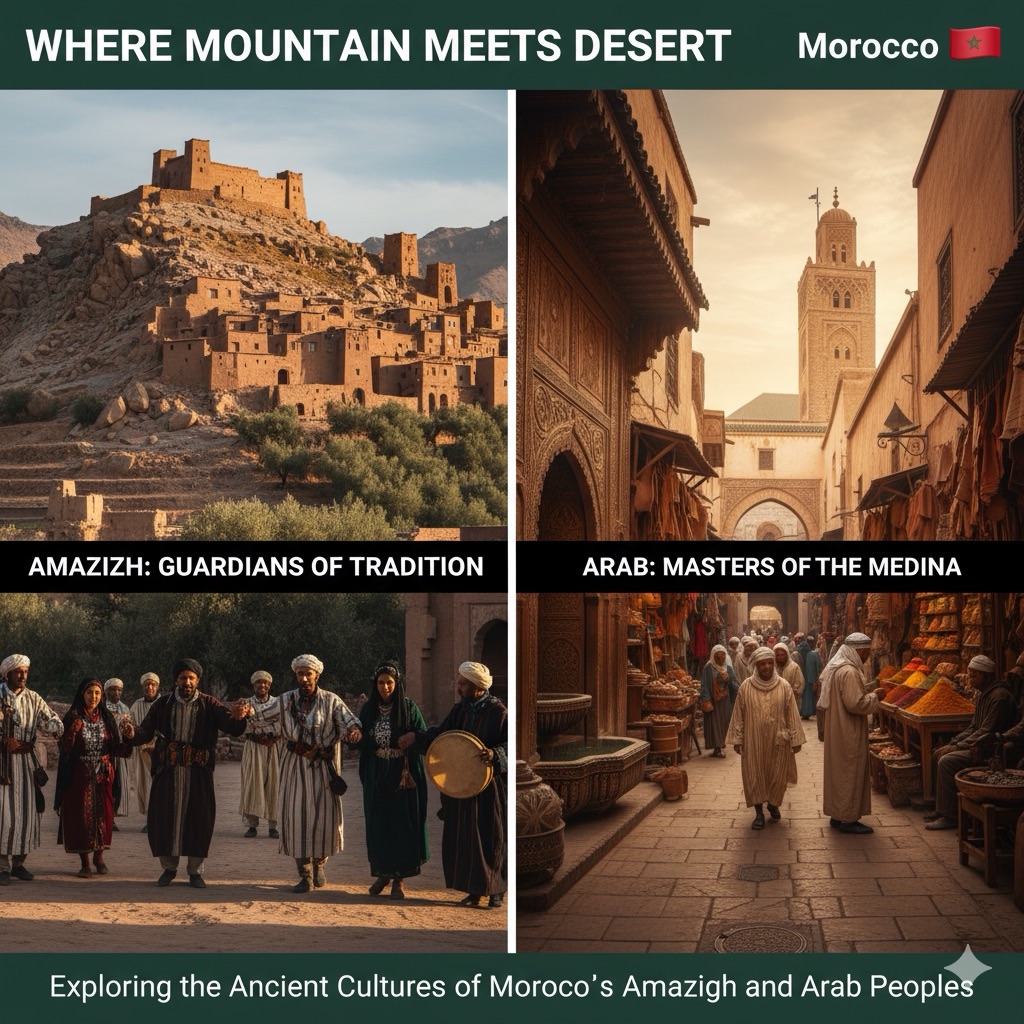
This image beautifully contrasts the rich cultural landscapes of Morocco’s Amazigh and Arab peoples. On the left, an Amazigh village, nestled in a mountainous desert, showcases traditional architecture, while Amazigh dancers in traditional attire embody their role as ‘Guardians of Tradition.’ On the right, a bustling Moroccan Medina, with its vibrant markets and iconic minaret, represents the ‘Masters of the Medina’ and the urban heart of Arab culture. Titled ‘Where Mountain Meets Desert | Morocco 🇲🇦,’ this visual narrative captures the blend of ancient traditions and vibrant daily life explored in the article.
Our expansive journey through Africa’s diverse cultures now leads us to Morocco, the vibrant kingdom situated at the northwestern tip of the continent. Here, we delve into the traditions of the two major cultural streams that define the nation: the indigenous Amazigh (Berber) people, with their ancient languages, mountain strongholds, and rich artisanal heritage; and the Arab populations, whose influence arrived with the spread of Islam and is deeply rooted in Morocco’s cities, political structures, and religious life. Their interaction over centuries has created a unique and dynamic Maghrebi culture.
Morocco’s history is a story of mountains and trade routes, a unique blend of indigenous Berber resilience, Islamic empires, and Mediterranean exchange. This long history has forged a national identity that is Arab and Islamic, yet profoundly Amazigh in its roots (Bennani-Chraïbi, 1994).
The Amazigh: Guardians of the Mountains and Ancient Traditions
The Amazigh people are the original inhabitants of North Africa. In Morocco, they are concentrated primarily in the three major mountain ranges—the Rif, the Middle Atlas, and the High Atlas—and are divided into distinct dialect groups (e.g., Riffian, Tamazight, and Tashelhit).
* Tamazight Language and Identity: The Amazigh maintain their distinct cultural identity through their various dialects of the Tamazight language. The official recognition of Tamazight and its ancient script, Tifinagh, reflects a powerful movement to revitalize and celebrate this foundational cultural heritage.
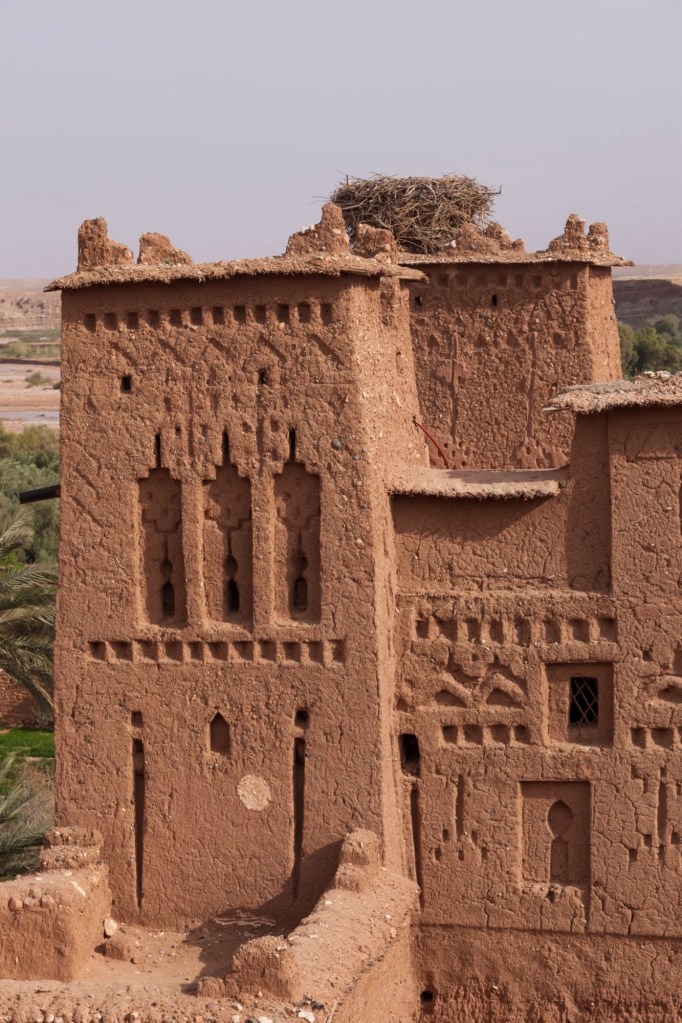
* Architecture and Adaptation: Amazigh architecture is a testament to adaptation. In the Atlas Mountains, they built impressive fortified villages (ksour) and communal granaries (igoudar), often constructed from packed earth, reflecting a tradition of collective security and resource management.
* Artisan Heritage: The Amazigh are renowned for their intricate artisan heritage, particularly carpet weaving, silver jewelry, and pottery. Amazigh carpets, often woven with geometric and abstract patterns, reflect regional styles and deep-seated symbolism related to fertility, protection, and the cosmos.
* Festivals and Music: Amazigh culture is rich in music and festivals. The Ahidous (Middle Atlas) and Ahwash (High Atlas) are large-scale, rhythmic dances performed in semi-circles by men and women, accompanied by drums and poetry, reinforcing communal solidarity.
The Arab Stream: Islamic Faith and Urban Centers
The Arab populations and the process of Arabization have been central to Morocco’s cultural and political development since the 7th century CE with the arrival of Islam.
* Islamic Faith and Institutions: The vast majority of Moroccans are Sunni Muslims. Islamic practices, festivals, and jurisprudence are integrated into daily life. The country’s historical capitals (Fes, Marrakech, Rabat, Meknes) are defined by their ancient mosques, Koranic schools (medersas), and traditional urban planning (medinas), which serve as centers of religious and intellectual life.
* The Darija Language: Moroccan Arabic (Darija) is the most widely spoken language. It is a unique dialect that has absorbed significant vocabulary and grammatical structures from Tamazight, Spanish, and French, distinguishing it from Middle Eastern Arabic.
* Urban Culture and Trade: Historically, Arab culture flourished in the major urban centers, often linked to international trade that connected the trans-Saharan routes with Europe and the Mediterranean. This is reflected in sophisticated crafts, cuisine, and elaborate urban social life.
A Unified Maghrebi Identity
Modern Moroccan culture is a powerful synthesis of these two great streams. The shared Islamic faith acts as a strong unifying factor, while the blending of languages (bilingualism is common), food, and artistic motifs demonstrates the seamless cultural fusion. Moroccan cuisine, for example, expertly combines North African staples with Amazigh agricultural products and Arab spices.
Morocco, with the enduring resilience of its Amazigh mountain communities and the deep Islamic traditions of its Arab cities, stands as a vibrant example of a diverse yet unified nation whose history is literally carved into its mountains and written across its deserts.
Our next article will take us to Mozambique, where we will explore the traditions of the Makua people, the largest ethnic group, and the Tsonga (Shangaan) people, with their rich musical heritage.
References:
* Bennani-Chraïbi, M. (1994). Soumis et rebelles: Les jeunes au Maroc. Paris: Presses de la Fondation nationale des sciences politiques.
* Ennaji, M. (2014). Multilingualism, Cultural Identity, and Education in Morocco. Springer.
* Vernet, J. (2012). The Berbers. Blackwell Publishing.


