The Roar of the Royal Drums, The Rhythms of the Woodland: Exploring the Cultures of Zambia’s Lozi and Bemba Peoples
By Kwadwo Afrifa – December 10, 2025 16:00
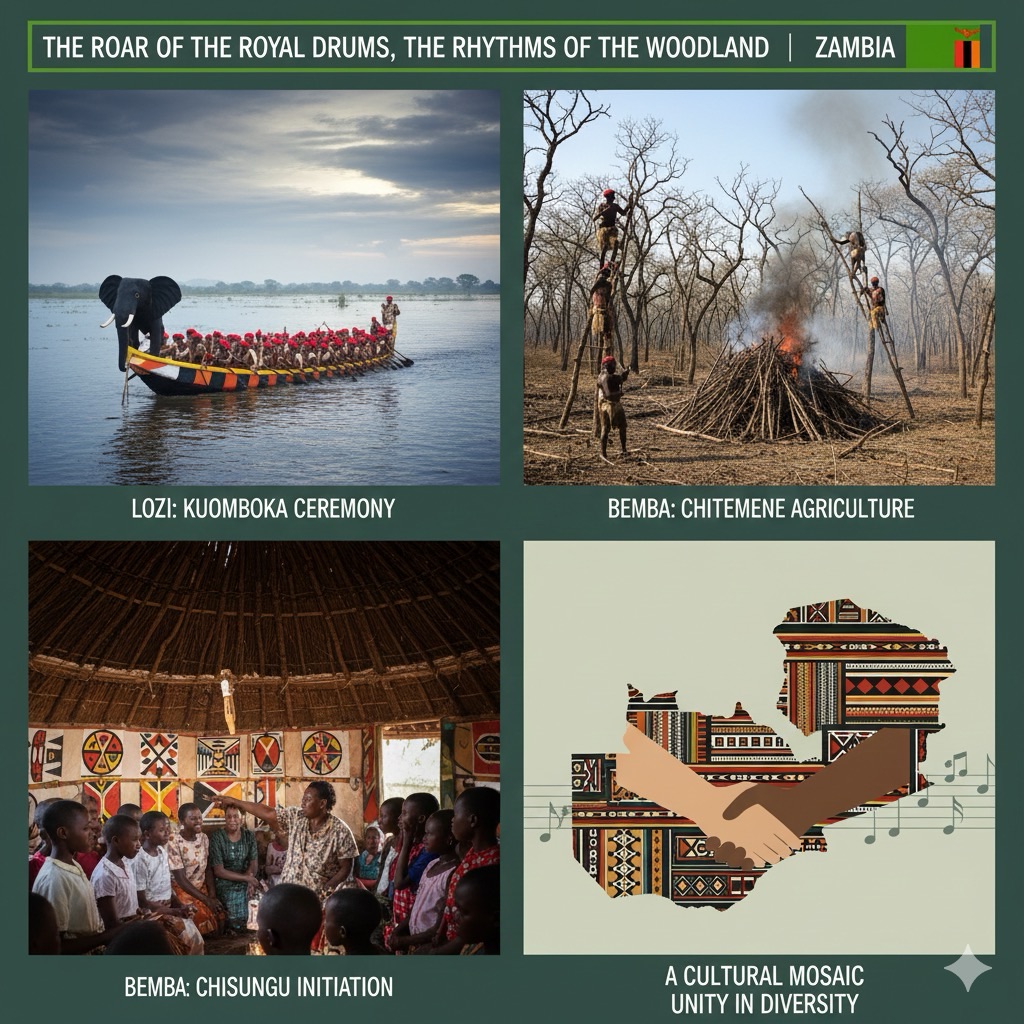
This image contrasts the defining traditions of Zambia’s two major cultures. The top left depicts the spectacular Nalikwanda royal barge, adorned with its elephant effigy, being paddled during the Kuomboka Ceremony, symbolizing the Lozi King’s (Litunga) annual migration from the rising floodwaters. The top right side illustrates the Chitemene shifting cultivation system of the Bemba, showing branches piled for burning in the Miombo woodland.
Our expansive journey through Africa’s diverse cultures brings us to Zambia 🇿🇲. Known for the thunderous Victoria Falls and vast wildlife reserves, Zambia is also a nation of profound cultural depth, home to over 70 ethnic groups. Here, we delve into the traditions of the Lozi people of the western floodplains, famous for one of Africa’s grandest water festivals, and the Bemba people of the northern woodlands, known for their unique agricultural systems and matrilineal heritage.
Zambia’s culture is defined by its landscape—from the seasonal flooding of the Zambezi River which shapes the Lozi way of life, to the immense Miombo woodlands that have dictated the history of the Bemba.
The Lozi: The Kuomboka and the Royal Barge
The Lozi people (or Barotse) inhabit the Western Province, a region historically known as Barotseland. Their culture is inextricably linked to the annual flooding of the Zambezi River, which transforms their dry plains into a vast inland sea.
* The Kuomboka Ceremony: The pinnacle of Lozi culture is the Kuomboka (“to get out of the water”). It is a ceremonial migration held at the end of the rainy season when the floodwaters rise in the Barotse Floodplain.
* The Journey: The Litunga (King) and his court move from their summer palace in the flooded plain (Lealui) to their winter palace on higher ground (Limulunga).
* The Nalikwanda: The King travels in a massive, spectacular royal barge called the Nalikwanda. Painted in black and white stripes (symbolizing the zebra), it is rowed by over a hundred paddlers dressed in traditional animal skins and red berets.
* The Royal Drums: The procession is announced by the deep, thundering beat of the Maoma royal drums, which are said to be heard for miles, signaling the King’s departure. On top of the barge sits a large elephant statue (representing the King’s strength) with ears that flap, while the Queen’s barge features a crane (representing grace).
The Bemba: Matriarchs of the Miombo
The Bemba people are the largest ethnic group in Zambia, dominating the Northern, Luapula, and Copperbelt provinces. Their history traces back to the great Luba Empire of the Congo, and their culture is adapted to the vast woodland environment.
* The Chitemene System: The Bemba developed a unique form of shifting cultivation known as Chitemene (“to cut”). To overcome the poor soil of the miombo woodlands, men climb trees to lop off branches, which are then piled in a central circle and burned. The crops (finger millet and cassava) are planted in the nutrient-rich ash bed. This system dictates the rhythm of village life and settlement patterns.
* Matrilineal Descent: Like many groups in the “matrilineal belt” of south-central Africa, the Bemba trace descent through the female line. The bond between brother and sister is paramount, and a man often relies on his maternal uncle for authority and inheritance.
* The Chisungu Initiation: The initiation of young girls into womanhood, known as Chisungu, is a complex ritual of high cultural importance. It involves weeks of seclusion where girls learn social obligations, marital duties, and the secrets of the clan.
* Mbusa: The teachings are conveyed through pottery emblems and wall paintings called Mbusa, which act as mnemonic devices for songs and proverbs regarding the duties of a woman.
A Nation of Copper and Culture
Zambia’s identity is a blend of these rural traditions and the urban culture of the Copperbelt, where the Bemba language has become the lingua franca of the mines and cities. Whether through the pageantry of the Nalikwanda cutting through the Zambezi floodwaters or the intricate teachings of the Chisungu in the north, Zambia preserves a heritage that honors both the power of nature and the strength of lineage.
Our next article will take us across the Zambezi to Zimbabwe. We will explore the stone-building legacy of the Shona people (Great Zimbabwe) and the spiritual music of the Mbira, as well as the martial history of the Ndebele people.
References:
* Gluckman, M. (1941). Economy of the Central Barotse Plain. Rhodes-Livingstone Institute. (A classic study on how the Lozi environment shapes their economy and culture).
* Richards, A. I. (1956). Chisungu: A Girl’s Initiation Ceremony Among the Bemba of Northern Rhodesia. Faber and Faber. (The definitive anthropological text on the Bemba initiation rites).
* Roberts, A. D. (1973). A History of the Bemba: Political Growth and Change in North-Eastern Zambia Before 1900. University of Wisconsin Press.


