The Rainbow Nation: Martial Spirits, Philosophies of Unity, and Rugged Roots in South Africa
By Kwadwo Afrifa – December 2, 2025 11:00
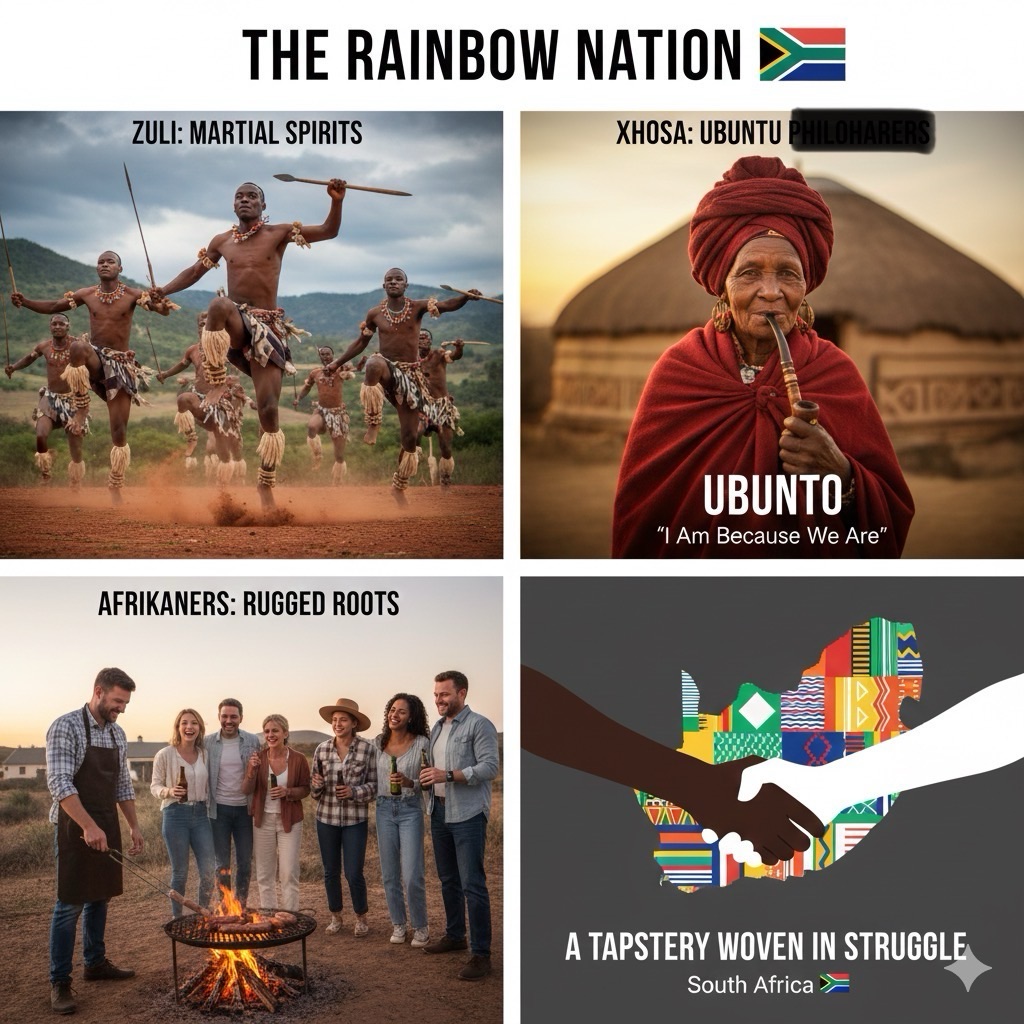
This tripartite image visually encapsulates the diverse cultural pillars of South Africa, the ‘Rainbow Nation.’ The top-left panel captures the energetic martial tradition of Zulu warriors performing the Indlamu dance, symbolizing their historical strength. The top-right panel depicts Xhosa and their philosophies of community. The bottom panel illustrates the rugged agrarian roots of Afrikaner culture, centered around the unifying social ritual of the braai. A central map graphic unites these distinct identities.
Our expansive journey through Africa’s diverse cultures brings us to the southern tip of the continent, to the economic and cultural powerhouse of South Africa. Often described as the “Rainbow Nation”—a term coined by Archbishop Desmond Tutu to describe the country’s multiculturalism after the fall of apartheid—South Africa is a land of profound complexity. Here, ancient indigenous traditions coexist with cultures forged during the colonial era, creating a society that is vibrant, sometimes volatile, but undeniably unique. We will delve into the traditions of the Zulu, the Xhosa, and the Afrikaners, three pillars of this diverse society.
South Africa’s history is etched into its landscape, from the rolling hills of KwaZulu-Natal to the rugged Karoo. It is a history of migration, conflict, and the eventual struggle for a unified democratic identity.
The Zulu: The People of Heaven and Martial Legacy
The Zulu people (amaZulu, “People of Heaven”) are the largest ethnic group in South Africa. Their identity is powerfully linked to the legacy of the Zulu Kingdom and the legendary King Shaka, who revolutionized military tactics in the early 19th century.
* The Martial Tradition: Zulu history is defined by the Mfecane (the crushing), a period of expansion and consolidation. Shaka introduced the short stabbing spear (iklwa) and the “horns of the buffalo” encircle-and-destroy tactic. Today, this martial heritage is celebrated in the Indlamu dance, where men in traditional skins high-kick and stomp the ground, simulating the movements of war.
* Social Structure (Amabutho): Traditional society was organized into age-grade regiments (amabutho). Loyalty to the King (Isilo) remains a potent force in modern politics and culture.
* The Reed Dance (Umhlanga): Similar to their Swazi neighbors, the Zulu celebrate the Umhlanga, where thousands of young women present reeds to the King, celebrating purity and national pride.
* Beadwork as Language: Zulu beadwork is not merely decorative; it is a complex communication system. The colors and patterns of a necklace or bracelet can convey messages of love, marital status, or warning, readable only to those who know the code.
The Xhosa: The Philosophers of Ubuntu
The Xhosa people (amaXhosa) inhabit the Eastern Cape and are known for their complex “click” language (isiXhosa), their deep intellectual tradition, and their pivotal role in the struggle against apartheid (leaders like Nelson Mandela, Walter Sisulu, and Thabo Mbeki were Xhosa).
* Ubuntu: “I Am Because We Are”: The Xhosa are the primary custodians of the philosophy of Ubuntu. It is a humanist worldview asserting that a person is a person through other people. It emphasizes compassion, community, and the idea that our humanity is inextricably bound up in the humanity of others.
* Ulwaluko (Initiation): The transition from boyhood to manhood is strictly governed by Ulwaluko. Young men (abakhwetha) are circumcised and live in isolation in the bush for weeks, covered in white clay (ingceke), to learn the secrets of manhood and responsibility. Returning to the community is a major celebration of rebirth.
* Red Ochre and Pipes: Traditional Xhosa aesthetics are striking. Women often wear distinctive turbans and skirts dyed with red ochre (imbola), and smoking long-stemmed wooden pipes is a traditional practice among elder women, symbolizing their status and wisdom.
The Afrikaners: A Culture Forged on the Veld
The Afrikaners are a unique cultural group in Africa, descended primarily from Dutch, French, and German settlers who arrived in the 17th and 18th centuries. Over time, they developed a distinct identity, language, and culture severed from Europe and rooted in the African soil.
* Afrikaans: Their language, Afrikaans, evolved from 17th-century Dutch but integrated words from Malay, Portuguese, and indigenous Khoisan and Bantu languages. It is one of the youngest languages in the world to have a full library of literature and science.
* The Trekker Spirit: Afrikaner identity was heavily shaped by the Great Trek of the 1830s, where “Voortrekkers” moved inland to escape British rule, facing immense hardship. This fostered a culture of rugged individualism, Calvinist faith, and a deep attachment to the land (die grond).
* The Braai: If there is one ritual that unites Afrikaners (and now all South Africans), it is the Braai (barbecue). It is not just cooking; it is a social institution. Gathering around a wood fire to grill boerewors (farmer’s sausage) is the quintessential expression of hospitality and leisure.
* Rugby: Rugby is more than a sport; it is a secular religion for many Afrikaners, serving as a focal point for community pride and, famously in 1995, national reconciliation.
A Tapestry Woven in Struggle
South Africa’s culture is the result of the collision and eventual weaving together of these distinct threads. From the Ubuntu of the Xhosa that guided reconciliation, to the martial pride of the Zulu, to the rugged resilience of the Afrikaners, the nation is a complex, living experiment in diversity.
Our next article will take us to the world’s youngest nation, South Sudan. We will explore the traditions of the Dinka and Nuer peoples, focusing on their profound “cattle camp” culture and the scarification markings that define their identities.
References:
* Giliomee, H. (2003). The Afrikaners: Biography of a People. University of Virginia Press.
* Laband, J. (1995). Rope of Sand: The Rise and Fall of the Zulu Kingdom in the Nineteenth Century. Jonathan Ball.
* Peires, J. B. (1982). The House of Phalo: A History of the Xhosa People in the Days of Their Independence. University of California Press.
* Tutu, D. (1999). No Future Without Forgiveness. Doubleday.


