Shadows of the Secret Society: Exploring the Masked Dances and Agricultural Traditions of Malawi’s Chewa and Lomwe Peoples
By Kwadwo Afrifa – November 17, 2025 13:00
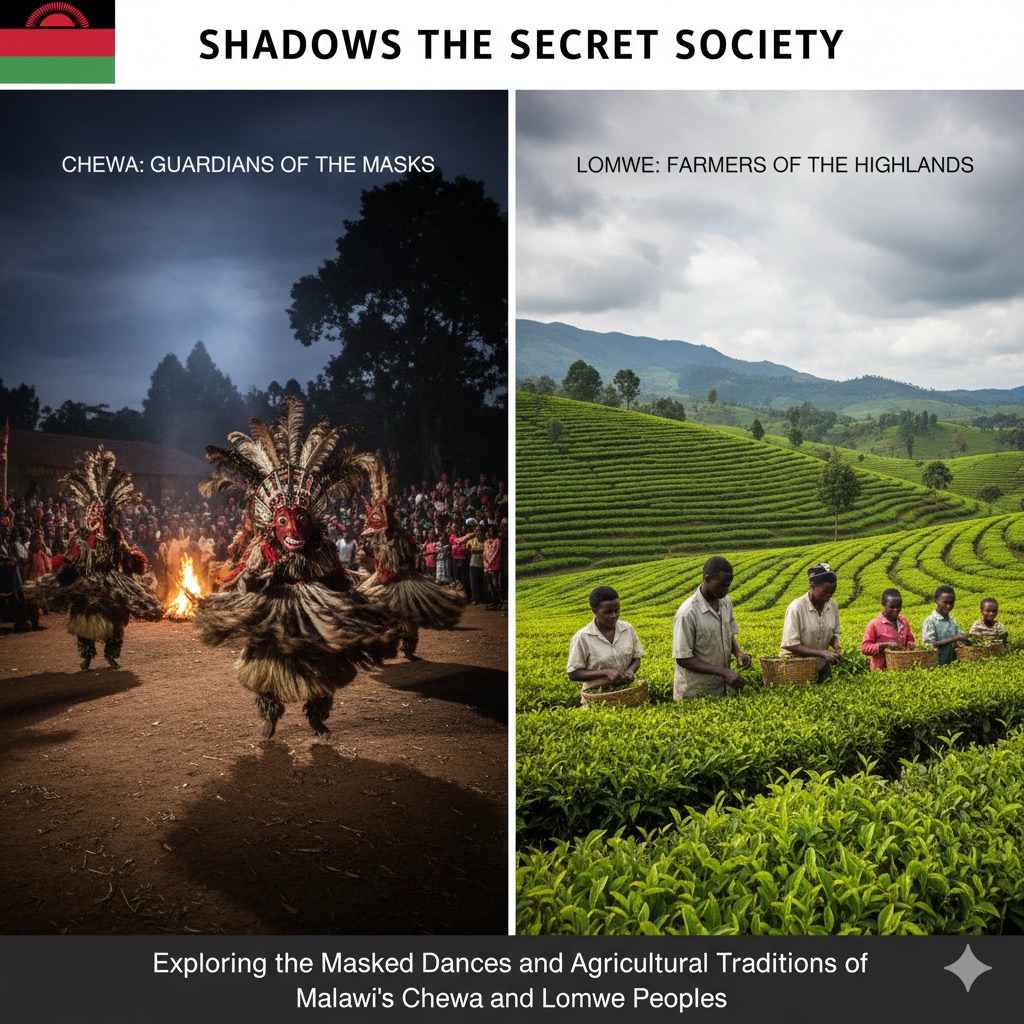
This image juxtaposes the vibrant cultural expressions of Malawi’s Chewa and Lomwe peoples. On the left, Chewa Gule Wamkulu dancers, adorned in elaborate masks and costumes, perform by firelight, embodying the spiritual depth of the ‘Shadows of the Secret Society’ and their role as ‘Guardians of the Masks.’ On the right, Lomwe farmers meticulously tend to tea plantations in the lush highlands, representing their significant contribution as ‘Farmers of the Highlands’ to Malawi’s agricultural landscape.
Our expansive journey through Africa’s diverse cultures now leads us to Malawi, the “Warm Heart of Africa,” a nation defined by the immense Lake Malawi and its fertile highlands. Here, we delve into the distinct yet intermingled traditions of the Chewa (Chêwa) people, the largest ethnic group, famous for their powerful Nyau secret society, and the Lomwe people, who migrated from Mozambique and contribute significantly to the country’s cultural mosaic. Their cultures offer a compelling study of spiritual secrecy, historical migration, and deep connection to the land.
Malawi’s cultural landscape is strongly tied to the historical movements of Bantu-speaking peoples, particularly the Maravi Confederacy (of which the Chewa were a core component) and later, the Lomwe migrations from the east during the late 19th and early 20th centuries. This history results in a blend of agricultural practices, ritual societies, and traditional governance (Pachai, 1973).
The Chewa: Nyau and the Cosmology of the Mask
The Chewa people are a Bantu group inhabiting the central and southern regions of Malawi, and neighboring areas of Zambia and Mozambique. Their culture is arguably most famous for its profound spiritual and social institution.
* The Nyau Secret Society: The cornerstone of Chewa traditional life is the secret Nyau society, primarily for men, which is closely linked to the ancestral realm and rites of passage. Nyau is both a religious cult and an educational institution, responsible for teaching moral codes, ancestral history, and maintaining social order. The society operates in relative secrecy, with performances and rituals taking place in designated sacred enclosures (Schoffeleers, 1999).
* The Masked Dances (Gule Wamkulu): The Nyau society’s most visible and spectacular expression is the Great Dance (Gule Wamkulu), now recognized by UNESCO as Intangible Cultural Heritage. Dancers wear elaborate wooden and basket masks or costumes (zirombo, ‘wild animals’), each representing a specific spirit, animal, ancestor, or modern phenomenon (e.g., colonial figures). These masks appear at funerals, initiation ceremonies, and installation of chiefs, mediating between the living and the spirit world.
* Matrilineal System: Chewa society is predominantly matrilineal, meaning descent, property inheritance, and succession to certain chieftaincies are traced through the mother’s line. The lineage head (phiri) and the village headwoman (anamfumu) hold significant social power.
* Agricultural Livelihoods: The Chewa are traditional agriculturalists, cultivating staples such as maize (nsima being the primary food), cassava, and groundnuts.
The Lomwe: Migration, Identity, and Cultural Fusion
The Lomwe people are a large group whose ancestors migrated into Malawi from Mozambique, particularly settling in the fertile southern districts. Their culture reflects this history of migration and subsequent integration.
* History of Migration: The Lomwe migrations were often triggered by political instability, drought, and economic pressures in Mozambique during the late 19th century. Their arrival introduced new dialects and customs to southern Malawi.
* Livelihoods and Farming: Like the Chewa, the Lomwe are primarily agriculturalists, excelling at farming maize, millet, and, importantly, playing a major role in the cultivation of cash crops like tea and tobacco in the southern highlands.
* Cultural Fusion: Over time, the Lomwe have experienced significant cultural exchange with the Chewa, Yao, and Mang’anja peoples. While maintaining their distinct language (Chilomwe) and some unique traditions (like specific dances and ceremonies), there has been substantial intermarriage and adoption of local practices, leading to a rich cultural fusion in the south.
A Shared Malawian Identity
The Chewa and Lomwe, along with other groups, contribute to the tapestry of Malawian identity. While the Chewa represent the powerful historical and ritual core of the central region, the Lomwe embody the nation’s history of migration and its ongoing process of cultural integration. The shared reliance on agriculture and the vibrant tradition of music and dance underscore the communal spirit of the “Warm Heart of Africa.”
The Chewa, with their profound Nyau secret society and the spectacle of Gule Wamkulu, and the Lomwe, with their resilient heritage of migration and adaptation, collectively illustrate the dynamic and rich cultural life that flourishes around the great lake.
Our next article will take us to Mali, where we will explore the traditions of the Dogon people, famous for their unique cosmology and mask dances, and the Tuareg people, the legendary nomadic “blue men” of the Sahara.
References:
* Pachai, B. (1973). Malawi: The History of the Nation. Longman.
* Schoffeleers, J. M. (1999). In Search of Ancestors: Man and Gods in the Chewa Oral Tradition. University of Malawi.


