Scent of Cloves, Spirit of the Wood: Exploring the Swahili and Makonde Cultures of Tanzania
By Kwadwo Afrifa – December 5, 2025 15:00
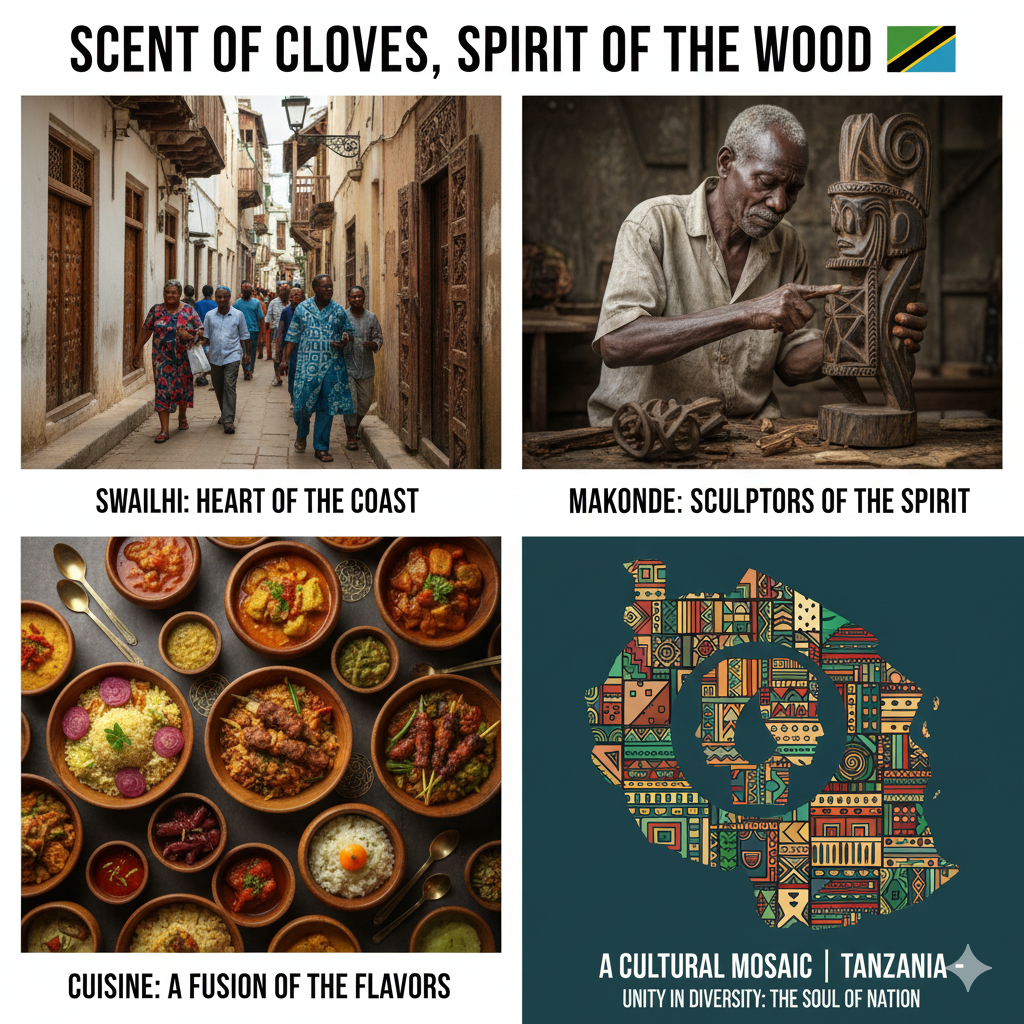
Our expansive journey through Africa’s diverse cultures brings us to Tanzania. Home to the snow-capped Kilimanjaro and the vast Serengeti, this East African nation is a powerhouse of cultural diversity.1 While it shares the famous Maasai people with Kenya, Tanzania offers unique cultural treasures of its own.2 Here, we delve into the cosmopolitan Swahili culture of Zanzibar and the coast, born from the Indian Ocean trade, and the Makonde people of the south, renowned globally as master sculptors of the spirit world.
Tanzania is unique in Africa for its successful promotion of Kiswahili as a unifying national language, which has helped suppress tribalism and foster a strong sense of national identity (Utaifa).3
The Swahili: A Civilization of the Coast
The Swahili culture is not attributed to a single “tribe” in the traditional sense, but is rather a civilization born from centuries of interaction between the indigenous Bantu people of the coast and merchants from Arabia, Persia, and India.4 Nowhere is this more visible than on the archipelago of Zanzibar.
- Stone Town: The heart of Swahili culture is Stone Town, a UNESCO World Heritage site.5 It is a labyrinth of narrow alleys defined by its architecture: coral-stone houses with imposing, intricately carved wooden doors.6 These doors are status symbols; the style of carving (Indian lotus or Arab geometric patterns) reveals the lineage and wealth of the owner.7
- A Fusion of Flavors: Zanzibar is known as the “Spice Island.”8 Swahili cuisine is a literal melting pot, blending African staples with Indian spices and Arab techniques.9 Dishes like Pilau (spiced rice), Biryani, and Urojo (a tangy flour-based soup) reflect this heritage.10 The air in the plantations is thick with the scent of cloves, nutmeg, and cinnamon.
- Taarab Music: The soul of Zanzibar is Taarab. This musical genre blends African percussion with Egyptian orchestras and Indian melodies. It is often performed at weddings, featuring poetic lyrics (mashairi) that subtly comment on social life and romance.11
The Makonde: Sculptors of the Spirit
In the south of Tanzania (and northern Mozambique), reside the Makonde people.12 While they are successful farmers, they are internationally celebrated for their extraordinary artistic heritage.13
- Masters of Blackwood: The Makonde are arguably the finest woodcarvers in East Africa. They work primarily with African Blackwood (mpingo), an incredibly dense and difficult timber.14 Unlike much “tourist art,” traditional Makonde carving is deeply spiritual and expressive.
- Styles of Carving:
- Ujamaa (Tree of Life): These sculptures depict a central figure surrounded by cascading, interlocking figures of family members, representing generations supporting one another. It became a national symbol of unity.
- Shetani (Spirit): A more abstract and surreal style depicting spirits (shetani) from Makonde folklore.15 These figures are often distorted, with one eye or elongated limbs, representing the fluidity of the spirit world.
- Mapiko Masquerade: The Makonde maintain a vibrant mask tradition called Mapiko.16 Used in initiation rites to mark the transition to adulthood, dancers wear helmet masks that often caricature local personalities or depict spirits, instilling moral lessons through fear and humor.
- Matrilineal Strength: The Makonde traditionally follow a matrilineal system.17 Women are highly respected, and the famous Makonde carvings often depict a female figure as the progenitor of the tribe.18
The Sukuma: The Dance of the Snake
While the Swahili and Makonde are culturally distinct, the Sukuma are the largest ethnic group in Tanzania, living near Lake Victoria.19 They are famous for their competitive dance societies.
- Snake Dancers: The Bugobogobo is a spectacular harvest dance where farmers use hoes as props. However, the Sukuma are most famous for their snake charmer societies (Buyeye), where dancers perform with large, venomous snakes to demonstrate courage and spiritual protection, traditionally used to heal and drive out evil spirits.
A Union of Cultures
Tanzania stands as a testament to cultural cohesion. From the Islamic call to prayer echoing over the carved doors of Zanzibar to the rhythmic chipping of Makonde chisels in the south, the nation has woven its diverse threads into a strong, unified fabric.
Our next article will take us to Togo. We will explore the spiritual heartland of the Ewe people (the birthplace of Voodoo) and the architectural marvels of the Batammariba people’s tower houses.
References:
- Askew, K. M. (2002). Performing the Nation: Swahili Music and Cultural Politics in Tanzania.1 University of Chicago Press. (A seminal work exploring how Swahili culture, particularly Taarab music, was utilized to construct a unified Tanzanian national identity).2
- Gunderson, F. (2010). We Never Sleep We Dream of Farming: Sukuma Labor Songs from Western Tanzania.3 Brill. (Provides in-depth analysis of Sukuma labor associations and dance societies, including the Bugobogobo).
- Kingdon, Z. (2002). A Host of Devils: The History and Context of the Making of Makonde Spirit Sculpture. Routledge.4 (The definitive text on the evolution of Makonde Shetani and Ujamaa carving styles and their spiritual roots).
- Middleton, J. (1992). The World of the Swahili: An African Mercantile Civilization. Yale University Press. (A comprehensive anthropological study of Swahili society, including Stone Town architecture and social stratification).5
- Sheriff, A. (1987). Slaves, Spices and Ivory in Zanzibar: Integration of an East African Commercial Empire into the World Economy, 1770-1873.6 James Currey. (Essential historical context for the rise of Zanzibar and the fusion of cultures in the Indian Ocean trade).


