Resilience of the Rice Fields, Endurance of the Herd: Exploring the Cultures of Guinea-Bissau’s Balanta and Fula Peoples
By Kwadwo Afrifa – November 6, 2025 12:00
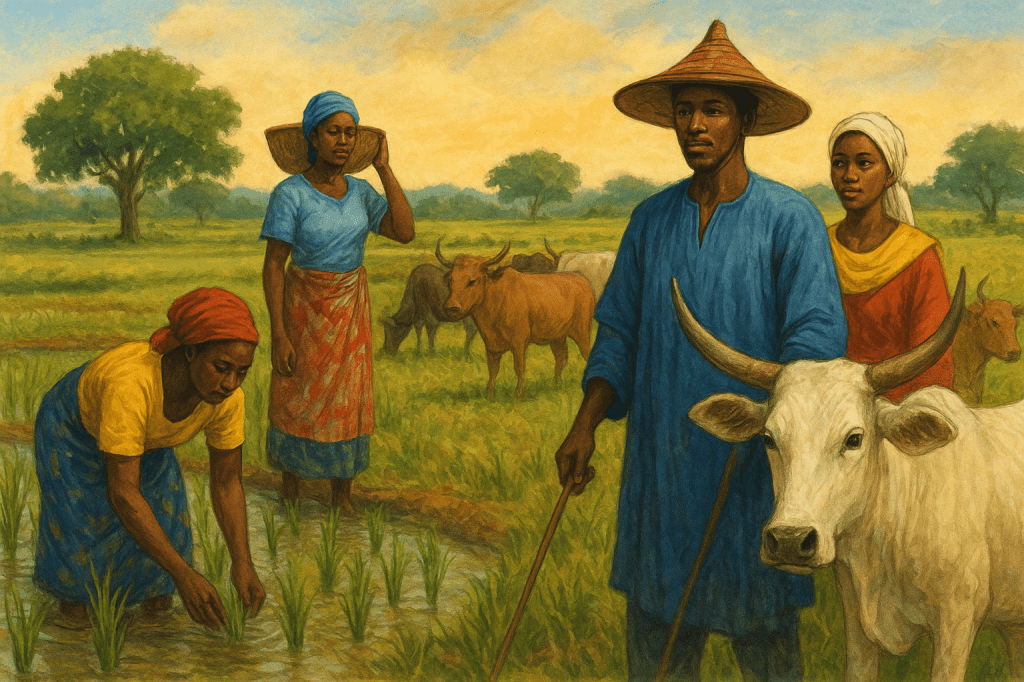
Balanta women tend to rice fields as a Fula herder guides his cattle across the plains—an image of coexistence and endurance reflecting Guinea-Bissau’s rich cultural tapestry.
Our expansive journey through Africa’s diverse cultures now leads us to Guinea-Bissau, a nation known for its low-lying coastal plains, lush riverine deltas, and the Bijagós archipelago. Here, we delve into the traditions of the country’s largest ethnic group, the Balanta, and the influential Fula (Fulani) people, focusing on their contrasting yet resilient social organizations, traditional livelihoods, and cultural distinctiveness in the Senegambian region.
Guinea-Bissau’s history is marked by its difficult colonial past and the complex interactions between its diverse ethnic groups, shaped by both the coastal environment and the interior savannahs.
The Balanta: Decentralized Resilience and Rice Cultivation
The Balanta people (meaning “those who resist” in their language) are the largest ethnic group in Guinea-Bissau, primarily concentrated in the central and southern regions. Their culture is defined by a historical rejection of centralized authority, their skill as farmers, and a strong emphasis on egalitarianism.
* Egalitarian and Decentralized Society: Historically, the Balanta maintained a remarkably decentralized social structure, resisting the establishment of formal kingdoms or hierarchical systems. Governance traditionally rested with councils of elders and age-grade associations, promoting a strong sense of communal responsibility and relative egalitarianism (Blyden, 1999). This structure was key to their historical resistance against both colonial and pre-colonial political dominance.
* Masters of Rice Cultivation: The Balanta are renowned as highly skilled rice cultivators. They developed sophisticated techniques for working the low-lying, swampy coastal lands, including building dikes and employing rotational practices to maximize yields in challenging environments. Rice is not just a staple food but is central to their social and ceremonial life.
* Initiation and Rites of Passage: The transition to adulthood is marked by elaborate initiation ceremonies (Fanado), which involve ritual isolation and instruction, culminating in the acceptance of young men and women into the community’s adult ranks, where they assume greater social and civic responsibilities.
The Fula (Fulani): Hierarchy, Islamic Faith, and Pastoralism
The Fula people (also known as Fulani, Fulbe, or Peul) are the second-largest ethnic group, primarily inhabiting the eastern and northern regions, bordering Senegal and Guinea. Their culture in Guinea-Bissau is largely characterized by their adherence to Islam, a more hierarchical social structure, and their historical nomadic roots.
* Hierarchical Social Structure: Unlike the Balanta, Fula society in this region is often characterized by a more hierarchical structure, historically composed of distinct social strata, including nobility, commoners, and occupational castes.
* Pillars of Islamic Faith: The Fula are profoundly Muslim (Sunni), with Islamic scholarship and tradition deeply influencing their legal, educational, and social systems. Their historical presence and influence contributed significantly to the spread of Islam in the interior of Guinea-Bissau.
* Pastoralist Heritage: While many Fula have settled and engage in farming, their cultural identity is strongly rooted in pastoralism, specifically the herding of cattle. This heritage informs their values (Pulaaku) and their traditions, which emphasize modesty, patience, and self-reliance (Riesman, 1977).
* Oral Tradition and Adornment: The Fula maintain a rich oral tradition in their language (Fulfulde or Pulaar), encompassing poetry and proverbs. Their aesthetic sense is often displayed through elaborate personal adornment, intricate hairstyles, and the decoration of their utilitarian objects.
Cultural Coexistence and National Identity
The Balanta and Fula peoples, along with the many other ethnic groups (like the Mandinka, Papel, and Bijagós) in Guinea-Bissau, contribute to a richly diverse nation. The country’s history, particularly its struggle for independence led by Amílcar Cabral, emphasized unity among these disparate groups.
Today, while navigating the challenges of a developing nation, both the Balanta and Fula communities strive to preserve their distinct languages and cultural practices—the Balanta maintaining their egalitarian, agrarian identity, and the Fula upholding their Islamic and pastoral heritage—all within the shared cultural landscape of Guinea-Bissau.
References:
* Blyden, N. (1999). West Africans in Central Africa: The Making of an African Diaspora. University of Rochester Press. (Discusses Balanta resistance and migration).
* Riesman, P. (1977). Freedom in Fulani Social Life: An Anthropological Study of the Fulani of Niger. Basic Books. (Provides core understanding of Fula values, applicable to the broader region).


