Pyramids of the Sands, Dervishes of the Nile: Exploring the Ancient and Mystical Cultures of Sudan
By Kwadwo Afrifa – December 5, 2025 14:00
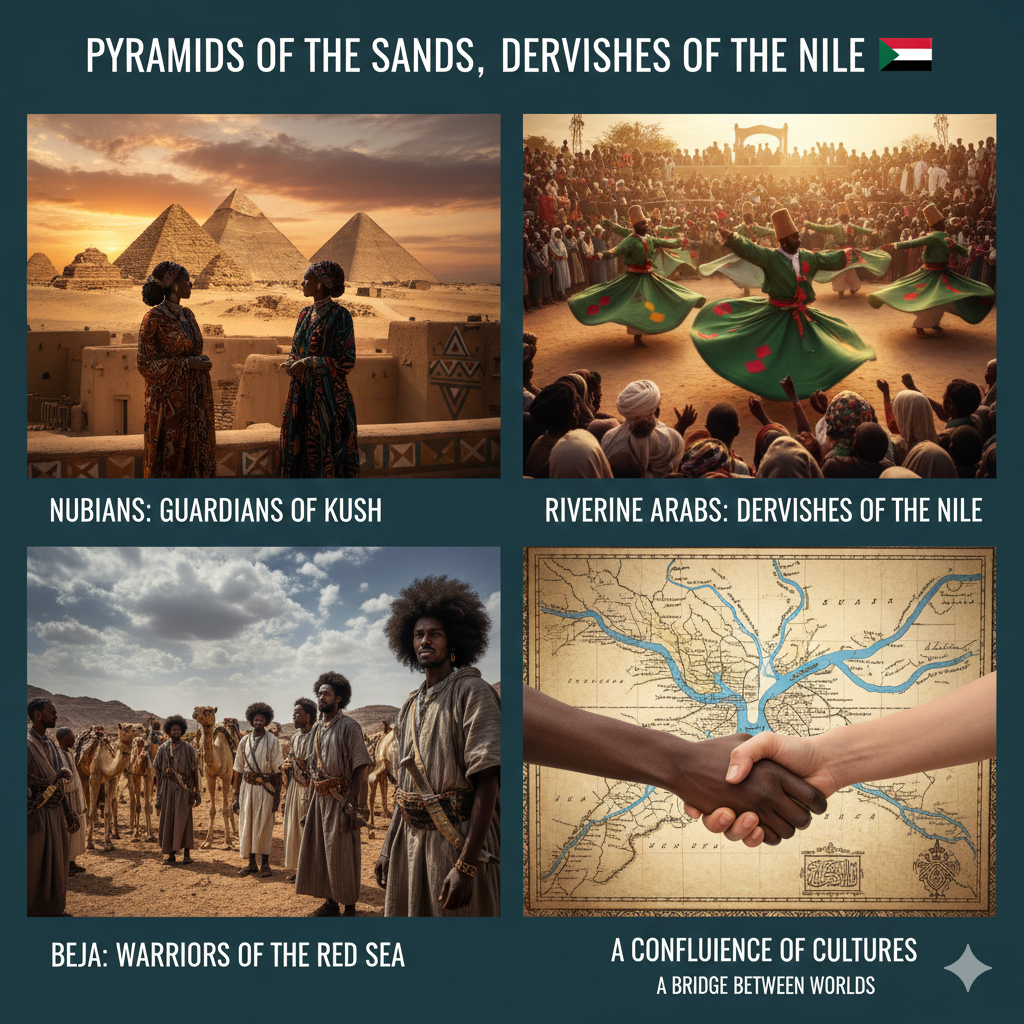
Our expansive journey through Africa’s diverse cultures flows north along the White Nile, crossing the border into Sudan. This is a land of profound historical depth, where the sands of the Sahara meet the fertile banks of the Nile. It is the home of the “Black Pharaohs” and a unique cultural crossroads where African roots and Arab influences have intertwined for over a millennium.1 Here, we delve into the enduring traditions of the Nubian people, heirs to one of the world’s oldest civilizations, and the Riverine Arab populations, known for their deep Sufi mysticism and poetry.
Sudan’s identity is anchored by the confluence of the Blue and White Niles at Khartoum. This geography has historically made it a bridge between the Mediterranean world and Sub-Saharan Africa, creating a culture that is simultaneously distinct and a synthesis of both.2
The Nubians: Guardians of the Black Pharaohs
The Nubian people (historically the Kushites) are among the oldest indigenous inhabitants of Africa. Their homeland, Nubia, stretches along the Nile from southern Egypt into northern Sudan. While modern borders have divided their land, their cultural memory remains unified.
- The Kingdom of Kush: Nubians are the direct descendants of the civilization of Kush (with capitals at Kerma, Napata, and Meroë). This powerful kingdom famously conquered Egypt in the 8th century BCE, establishing the 25th Dynasty of “Black Pharaohs.”3 Sudan today possesses more standing pyramids than Egypt, a testament to this architectural legacy .
- The Language of the Nile: The Nubian languages (such as Nobiin and Andaandi) belong to the Nilo-Saharan family.4 Despite the dominance of Arabic, these languages are fiercely preserved as the vessel of Nubian songs, proverbs, and identity.
- Artistic Vibrancy: Nubian culture is visually distinct. Their traditional mud-brick houses are famous for their geometric paintings and bright colors, often decorating the entrance gates with symbols of protection and welcome.5
- Displacement and Resilience: The construction of the Aswan High Dam in the 1960s flooded vast tracts of ancestral Nubia (creating Lake Nasser), forcing a traumatic mass migration.6 This event, known as “The Sorrows of Nubia,” is a central theme in modern Nubian music and poetry, which blends longing for the lost riverbanks with a celebration of survival.
The Riverine Arabs: Sufism and the Jebena
In the central clay plains and along the Nile north of Khartoum, the culture is dominated by Arabized Nubian groups (such as the Ja’aliyin, Shaigiya, and Danagla). These groups trace their lineage to Arab tribes but are culturally and genetically a fusion of the indigenous population and Arab migrants.
- Sufi Mysticism: The heartbeat of Sudanese Islam is Sufism. Unlike the austere forms of Islam found elsewhere, Sudanese Islam is mystical, communal, and filled with music.
- The Dervishes of Omdurman: Every Friday at the Hamed al-Nil tomb in Omdurman, Whirling Dervishes dressed in patchwork green and red robes gather to chant (Dhikr) and dance in dust-kicking circles to the beat of drums.7 It is a hypnotic spectacle of spiritual ecstasy designed to achieve unity with the divine .
- Poetry and Valor: The Shaigiya tribe is particularly renowned for its poetry and history of resistance (they fiercely fought the Ottoman-Egyptian invasion). Their poetry is often accompanied by the tambour (a lyre), singing of chivalry, love, and the beauty of the palm groves.
- The Jebena (Coffee Ceremony): Hospitality is sacred. The Jebena is a traditional clay coffee pot with a long neck and round base. Preparing coffee is a ritual involving roasting beans over charcoal, adding spices like ginger or cardamom, and serving it in tiny cups alongside dates or popcorn. It is the social anchor of every afternoon.
The Beja: The “Fuzzy-Wuzzies” of the East
While the Nile dominates the narrative, the eastern Red Sea hills are home to the Beja people.8 Known historically to the British as the “Fuzzy-Wuzzies” due to their distinctive afro-textured hairstyles, they are a non-Arab, Cushitic-speaking pastoralist group. They have inhabited the region for 4,000 years, famously resisting outside control from the Pharaohs to the British Empire, maintaining a fierce, independent culture centered on camels and the sword.
A Culture of Confluence
Sudan is a nation where the call to prayer echoes over ancient pyramids and where Arabic poetry is sung to African lyres. Despite the political turbulence and civil conflicts that have marred its modern history, the cultural bedrock of Sudan—defined by the resilience of the Nubians and the mystical hospitality of the Riverine Arabs—remains a profound testament to the power of synthesis.
Our next article will take us to Tanzania. We will explore the Swahili culture of Zanzibar (a blend of African, Arab, and Indian influences) and the traditions of the Makonde people, renowned for their intricate wood carvings.
References:
- Adams, W. Y. (1977). Nubia: Corridor to Africa. Princeton University Press.
- Holt, P. M., & Daly, M. W. (2011). A History of the Sudan: From the Coming of Islam to the Present Day. Longman.
- Trimingham, J. S. (1949). Islam in the Sudan.9 Oxford University Press.
- Welsby, D. A. (1996).10 The Kingdom of Kush: The Napatan and Meroitic Empires. British Museum Press.


