Nomads of the Savannah, Cultivators of the Highlands: Exploring the Cultures of Kenya’s Maasai and Kikuyu Peoples
By Kwadwo Afrifa – November 7, 2025 15:00
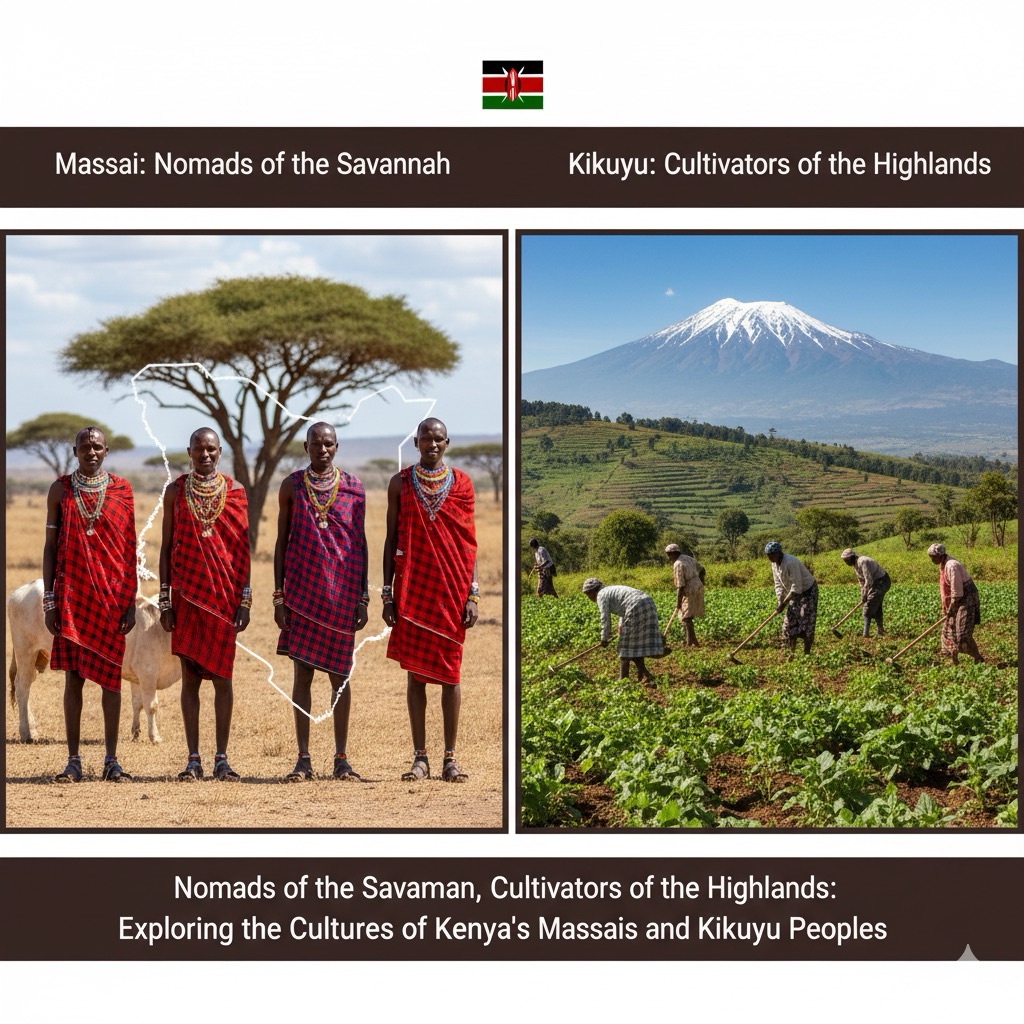
Our expansive journey through Africa’s diverse cultures now leads us to Kenya, a nation celebrated for its stunning landscapes and immense cultural diversity. Here, we delve into the distinct traditions of two of its most prominent and influential ethnic groups: the Maasai, famous for their unique pastoralist lifestyle, and the Kikuyu (Gĩkũyũ), the country’s largest ethnic group, known for their agricultural heritage and historical role in nation-building. Their contrasting livelihoods and social structures offer a compelling study of cultural adaptation and resilience in East Africa.
Kenya’s history is shaped by the great Rift Valley, which bisects the country, creating diverse ecological zones that historically supported the specialization of ethnic groups—pastoralists on the open plains and cultivators in the central highlands.
The Maasai: Warriors of the Rift Valley Plains
The Maasai people are a Nilotic group primarily inhabiting the semi-arid plains of southern Kenya and northern Tanzania. Their culture is arguably one of the most recognized globally, defined by its strong connection to cattle, a distinct age-set system, and vibrant traditional dress.
* Pastoralism and Cattle Centrality: The Maasai are traditionally nomadic or semi-nomadic pastoralists, believing that all cattle were originally given to them by God (Enkai). Cattle are central to their lives, serving as the primary source of wealth, status, and sustenance (milk, blood, and meat). Their movement is dictated by the search for grazing land and water, reflecting a deep, intimate knowledge of the savannah ecosystem (Talle, 1999).
* Age-Set System (Moru): Maasai society is fundamentally organized by an age-set system (Moru), which defines social roles and responsibilities. The initiation of young men into the warrior class (moran) is a critical rite of passage, involving specific ceremonies, distinct attire, and a period dedicated to protecting the community and its herds .
* Distinctive Dress and Adornment: They are known for their colorful checked cotton cloth wraps (shúkà), often dyed red, and their elaborate beadwork worn by both men and women, which conveys information about social status, age-set, and marital status. Their elaborate jumping dance (adumu) is also globally iconic.
* Spiritual Beliefs: Their religion centers on the benevolent, yet sometimes wrathful, God Enkai, who is manifested in color: Enkai Narok (Black God/Good God) brings rain, and Enkai Na-nyokie (Red God/Angry God) brings drought.
The Kikuyu: Masters of the Fertile Highlands
The Kikuyu people are a Bantu group primarily concentrated in the fertile, cool central highlands of Kenya, around Mount Kenya. Their history and culture are defined by their advanced agricultural skills, their traditional kinship systems, and their central role in Kenya’s struggle for independence.
* Agricultural Heritage: The Kikuyu are traditionally agriculturalists, benefiting from the rich, volcanic soil of their traditional lands. They cultivated a diverse range of crops, including yams, maize, and beans, and were known for their efficient land-use practices and irrigation techniques (Lonsdale, 1992).
* Kinship and Clans: Kikuyu society is structured around a patrilineal clan system (Mĩhĩrĩga), with deep emphasis on kinship and territorial integrity. Traditional governance was decentralized, resting on councils of elders (Kiama) who managed judicial, religious, and political affairs.
* Land and Identity: Land (Gĩthaka) is profoundly sacred to the Kikuyu, seen not merely as property but as the essence of identity, spirituality, and continuity with ancestors. The loss of land during the colonial period was a major driver of resistance movements.
* Profound Role in History: The Kikuyu played a pivotal role in Kenya’s path to independence, particularly through the Mau Mau uprising against British colonial rule, an event that profoundly shaped the nation’s political identity (Kenyatta, 1938).
* Spiritual Beliefs: Traditional Kikuyu beliefs centered on one supreme being, Ngai, who resides on the sacred Mount Kenya (Kirinyaga). All ceremonies and prayers were traditionally directed towards this mountain.
A Nation of Contrasts and Coexistence
The Maasai and Kikuyu, representing Kenya’s pastoralist plains and its intensive agrarian highlands, respectively, stand as powerful symbols of the country’s cultural diversity. While they have historically experienced periods of tension over land and resources, they coexist today, contributing significantly to Kenya’s economy and national identity. The vibrant cultural tapestry of Kenya is richer for the distinct traditions and resilience of both these groups.
Our next article will take us to Lesotho, a mountainous kingdom in Southern Africa, where we will explore the traditions of the Basotho people, known for their distinctive conical hats and blankets, and the centralized monarchy.
References:
* Kenyatta, J. (1938). Facing Mount Kenya. Vintage Books.
* Lonsdale, J. (1992). “The Moral Economy of Mau Mau: Wealth, Poverty, and Civic Virtue in Kikuyu Political Thought.” Unravelling the Maze: Essays on African Christianity, pp. 297-362.
* Talle, A. (1999). “Pastoralists at the Border: Maasai of Kenya and Tanzania.” Africa: Journal of the International African Institute, 69(4), pp. 581-605.


