Monarchs of the Lake, Lords of the Long Horn: Exploring the Royal Traditions of Uganda’s Baganda and Bahima Peoples
By Kwadwo Afrifa – December 7, 2025 12:00
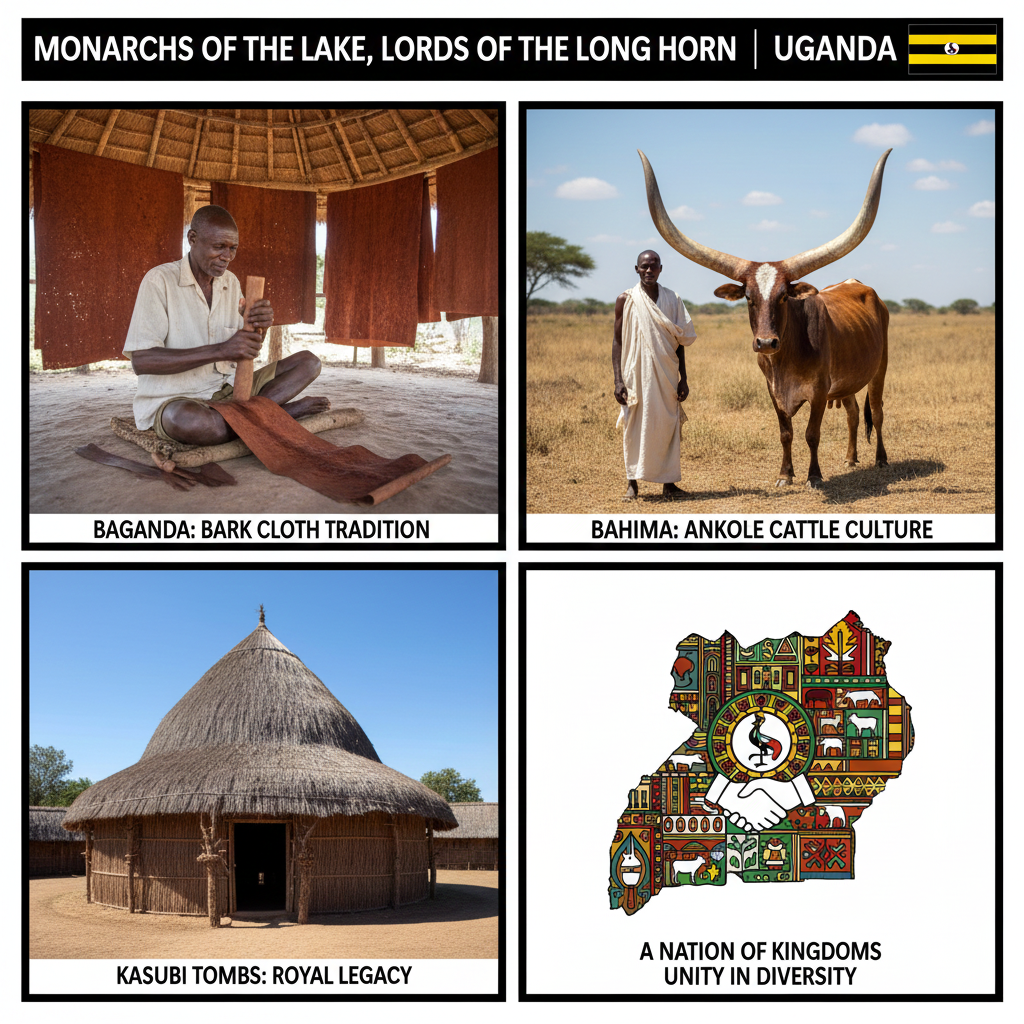
Our expansive journey through Africa’s diverse cultures brings us to the lush, equatorial landscapes of Uganda. Famously dubbed the “Pearl of Africa” by Winston Churchill, Uganda is a land where the savannah meets the rainforest.1 Here, the cultural narrative is dominated by the endurance of powerful traditional kingdoms and the distinct divide between the agrarian Bantu societies of the south and the pastoralist traditions of the west and north. We delve into the sophisticated court culture of the Baganda people (of the Buganda Kingdom) and the cattle-centric aristocracy of the Bahima people (of the Ankole Kingdom).
Uganda’s history is unique in East Africa for the strength and continuity of its centralized kingdoms, which survived colonization and political turmoil to remain vital cultural institutions today.
The Baganda: Bark Cloth and the Kabaka’s Tombs
The Baganda people are the largest ethnic group in Uganda, inhabiting the fertile northern shores of Lake Victoria. Their culture is synonymous with the Buganda Kingdom, a powerful entity with a complex political hierarchy centered on the King, or Kabaka.2
- The Kasubi Tombs: The spiritual heart of the Baganda is the Kasubi Tombs, a UNESCO World Heritage site.3 It is the burial ground of the Kabakas.4
- Architectural Marvel: The main building, Muzibu Azaala Mpanga, is a masterpiece of organic architecture.5 It is a massive dome structure constructed entirely from vegetal materials—wood, thatch, reed, and wattle—without a single nail.6 It represents the universe, with the Kabaka at its center, bridging the earthly and spiritual realms.
- The Ancient Craft of Bark Cloth (Lubugo): Long before the arrival of cotton or silk, the Baganda developed a unique textile: Bark Cloth.7 Recognized by UNESCO as a Masterpiece of the Oral and Intangible Heritage of Humanity, it is harvested from the Mutuba fig tree.8
- The Process: Craftsmen strip the bark (without killing the tree) and rhythmically beat it with grooved wooden mallets for hours until it stretches into a fine, terracotta-colored fabric. Historically worn by royalty, it is now used for coronation robes and healing rituals.9
- The Clan System: Every Muganda belongs to a clan named after a totem (e.g., Lion, Monkey, Yam).10 The clan system defines social roles; for instance, the Mushroom clan traditionally provides the Kabaka’s gatekeepers, while the Buffalo clan carries the King.
The Bahima: The Cult of the Ankole Cow
In the southwest, within the traditional Kingdom of Ankole (comprising the Banyankole people), society was historically stratified between the agricultural Bairu and the pastoralist elite, the Bahima.11
- The Ankole Long-Horned Cattle: For the Bahima, the Ankole cow is not livestock; it is sculpture. These cattle are famous for their colossal, lyre-shaped horns, which can span over two meters.
- Aesthetic Pastoralism: The Bahima breed these cows for beauty (bihogo – dark red coat) and horn shape, rather than meat yield. They are celebrated in heroic poetry, where a man might praise his favorite cow more fervently than he would a friend.
- Milk Culture: The diet and culture of the Bahima revolve around milk.12 They craft exquisite milk pots (Eyanzi) made from smoked wood and sealed with clay, often encased in intricate basketry.13 The presentation of milk is a ritual of hospitality, and strict taboos govern its consumption (e.g., never mixing milk with meat in the same stomach).
- The Art of the Hut: Traditional Bahima architecture consisted of grand, beehive-shaped huts. Inside, an artistic platform called the Orusika—decorated with geometric patterns in black, white, and red earth—separated the living area from the milk-churning sanctuary.
A Modern Kingdom Culture
Today, Uganda is a republic, but the “Cultural Institutions” (Kingdoms) were restored in 1993.14 The Kabaka of Buganda and the Omugabe of Ankole (though the latter’s political restoration is contested) remain powerful symbols of identity. Whether wrapped in the terra-cotta hues of bark cloth or herding the majestic long-horned cattle across the western hills, these traditions anchor the modern Ugandan identity in centuries of regal history.
Our next article will take us to Zambia. We will explore the wetlands of the West to witness the Lozi people’s spectacular Kuomboka ceremony, and the traditions of the Bemba people, the largest ethnic group in the country.
References:
- Roscoe, J. (1911). The Baganda: An Account of Their Native Customs and Beliefs.15 Macmillan. (A foundational ethnographic text on the structure of the Buganda Kingdom).
- Steinhart, E. I. (1978). “The Kingdoms of the March: Speculations on Social Inequality in Bunyoro and Buganda.” Journal of African History. (Provides context on the social stratification in Ugandan kingdoms).
- Venbrux, E., et al. (2016). Barkcloth in Uganda: Process, Product and Cultural Meaning. (A detailed look at the technical and cultural significance of Lubugo).


