Lords of the Nile, Keepers of the Long-Horned Cattle: Exploring the Dinka and Nuer Cultures of South Sudan
By Kwadwo Afrifa – December 4, 2025 11:00
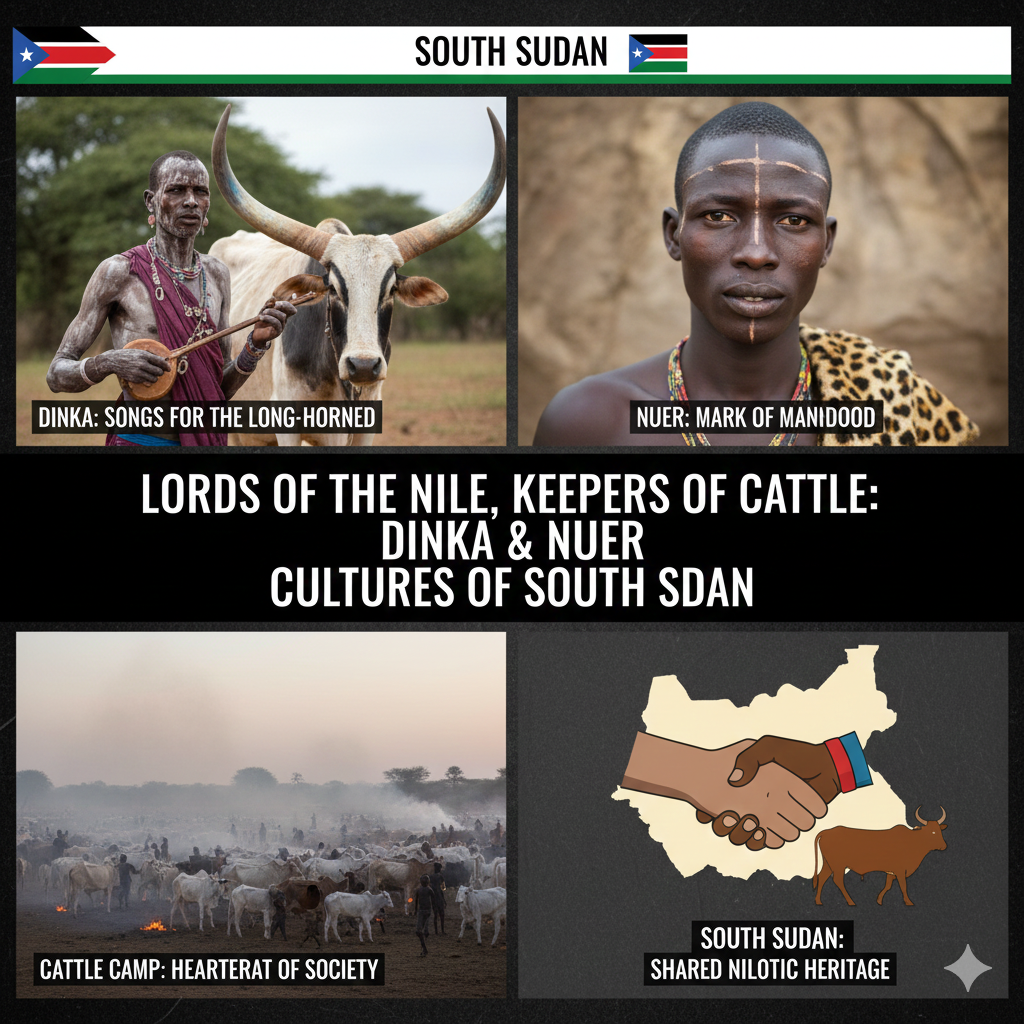
Our expansive journey through Africa’s diverse cultures brings us to the world’s youngest sovereign nation, South Sudan (independent since 2011).1 Born from decades of struggle, this land of vast wetlands (the Sudd) and savannahs is home to some of the most resilient pastoralist cultures on the planet. Here, we delve into the traditions of the Dinka (Jieng) and the Nuer (Naath) peoples. Despite distinct political histories, both groups share a profound Nilotic heritage where life revolves around the majestic long-horned cattle, and identity is etched into the skin.2
South Sudan’s culture is not defined by urban centers or stone monuments, but by the rhythm of the seasons—the dry season in the cattle camps (toic) and the wet season in the permanent settlements.
The Dinka (Jieng): The People of the People
The Dinka people (calling themselves Jieng or Muonyjang) are the largest ethnic group in South Sudan.3 They are legendary for their height, their pride, and their sophisticated monotheistic spirituality.
- The Divinity Nhialic: Dinka religion centers on a single supreme creator, Nhialic (who is in the sky).4 Spiritual intermediaries (jak) play a role in daily life, and the Spear Masters (bany bith) serve as powerful ritual leaders who mediate between the people and divinity, ensuring rain and health (Lienhardt, 1961).5
- The Ox-Name: The bond between a Dinka man and his cattle is so deep that when a young man is initiated, he takes the name of his favorite ox.6 He will compose songs praising the animal’s color, the shape of its horns, and its behavior.7 To insult a man’s ox is to insult the man himself.
- Initiation: Adulthood is marked by ritual scarification (historically, a V-shaped pattern on the forehead) and the removal of lower teeth, though these practices are evolving with modernization.
The Nuer (Naath): Egalitarian Warriors
The Nuer people (calling themselves Naath, “Human Beings”) are the second-largest group, inhabiting the swamps and savannahs of the Upper Nile.8 They are historically famous in anthropology for their unique political system.
- Ordered Anarchy: As described by E.E. Evans-Pritchard, traditional Nuer society had no central government or chiefs. Instead, it functioned through a system of “ordered anarchy” based on kinship obligations and a balance of power between lineages. Order was maintained by the Leopard-Skin Chief, a ritual mediator with no coercive power, who settled blood feuds (Evans-Pritchard, 1940).9
- The Gaar (Mark of Manhood): The most striking visual marker of Nuer identity is the Gaar. During initiation into adulthood (wut), young men endure the cutting of six distinct horizontal lines across the forehead.10 This painful rite is a test of courage; flinching is a disgrace. The scars act as a permanent badge of maturity and tribal belonging.
Life in the Cattle Camp (Wut)
For both the Dinka and Nuer, the Cattle Camp (wut) is the heartbeat of society. It is not merely a farm; it is a temple, a social club, and a bank.
- Wealth on Hooves: Cattle are the currency of life. They are used for bridewealth (dowry) to legitimize marriages, settle disputes, and pay fines. A man without cattle has no status.
- The Daily Rhythm: Life in the camp revolves to the needs of the herd. At dawn and dusk, the air is filled with the smoke of dung fires (burned to keep insects away), creating a distinct, hazy atmosphere.11 Young men cover themselves in ash to protect their skin and bleach their hair with cow urine, creating a striking orange/blond tint.
- Symbiosis: The relationship is symbiotic. Humans protect and groom the cattle, massaging their humps and singing to them; in return, the cattle provide milk, blood (often consumed raw or cooked), and urine (for antiseptic and tanning), but rarely meat, which is reserved for major sacrifices.
A Shared but Turbulent Heritage
The Dinka and Nuer share a common Nilotic ancestry, similar languages, and an almost identical reverence for cattle.12 However, this similarity has historically bred competition over grazing land and water, leading to cycles of conflict that have been exacerbated by modern politics.13 Yet, in the shared dust of the cattle camp and the shared rituals of the Nile, their cultural kinship remains undeniable.
Our next article will take us north to Sudan. We will explore the ancient legacy of the Nubian people (heirs to the Kushite Pharaohs) and the Arabized culture of the central riverine region.
References:
- Evans-Pritchard, E. E. (1940). The Nuer: A Description of the Modes of Livelihood and Political Institutions of a Nilotic People. Oxford University Press.
- Hutchinson, S. E. (1996). Nuer Dilemmas: Coping with Money, War, and the State. University of California Press.
- Lienhardt, G. (1961). Divinity and Experience: The Religion of the Dinka. Oxford University Press.


