Kingdoms in the Sky: Exploring the Unified Culture and Enduring Identity of Lesotho’s Basotho People
By Kwadwo Afrifa – November 10, 2025 13:00
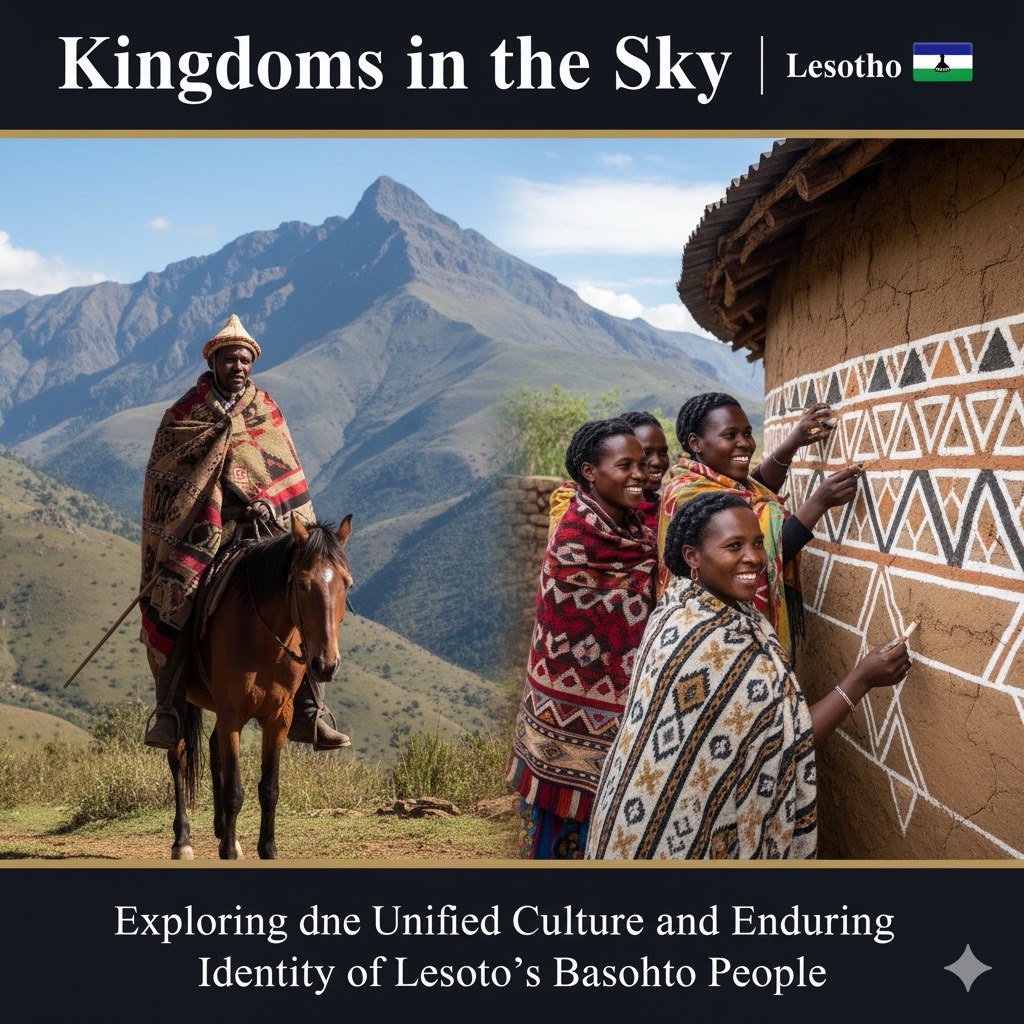
This image captures the essence of Lesotho, ‘The Kingdom in the Sky.’ On the left, a Basotho man on horseback, draped in the iconic Basotho blanket and wearing a mokorotlo hat, traverses the mountainous landscape. On the right, Basotho women adorn a traditional home with intricate Litema patterns, showcasing their artistic heritage. The majestic Maloti mountains in the background underscore the nation’s unique geographical identity, all unified under the banner of ‘Kingdoms in the Sky | Lesotho,’ symbolizing the Basotho people’s enduring culture and resilience.
Our expansive journey through Africa’s diverse cultures now leads us to Lesotho, a unique kingdom entirely landlocked within South Africa. Here, we delve into the rich and unified traditions of the Basotho people. Known for their distinctive conical hats (mokorotlo), colorful woven blankets, and centralized monarchy, the Basotho offer a compelling study of cultural cohesion, resilience, and adaptation to the challenging environment of the mountainous Maloti and Drakensberg ranges—earning the nation the moniker, “The Kingdom in the Sky.”
The Basotho nation was consolidated in the early 19th century under the leadership of King Moshoeshoe I, who skillfully united various Sotho-speaking clans during a tumultuous period (Difaqane or “The Crushing”). By strategically positioning his people atop the impregnable mountain fortress of Thaba Bosiu, he protected his realm and laid the foundation for an enduring independent nation (Eldredge, 1993).
The Enduring Symbolism of Basotho Attire
Basotho culture is immediately recognizable through its iconic traditional attire, which is deeply practical, symbolic, and an essential marker of national identity.
* The Basotho Blanket (Kobo): Perhaps the most famous cultural symbol, the heavy, patterned Basotho blanket is worn year-round over the shoulders, serving as protection against the cold mountain climate. Each pattern and color combination carries specific symbolic meaning related to historical events, royal lineage, or initiation status. The blanket is central to rites of passage and is considered a national dress .
* The Mokorotlo Hat: The conical, woven grass hat (mokorotlo) is the national emblem of Lesotho. Its shape is said to mimic the peak of the iconic Mount Thaba Bosiu (the fortress of King Moshoeshoe I). It is traditionally worn by Basotho men and symbolizes their unity and connection to the land and history.
Monarchy and Political Cohesion
Lesotho remains one of Africa’s few traditional kingdoms with a powerful cultural continuity. The monarchy, while now constitutional, remains the spiritual and symbolic head of the Basotho nation.
* Centralized Authority: The history of strong centralized leadership established by Moshoeshoe I is deeply respected. Traditional chiefs and the King act as custodians of the land (lefatshe) and traditional law (molao), helping to maintain social order and cohesion (Ashton, 1952).
* Social Structure: Society is organized around patrilineal descent and kinship ties, with the extended family remaining the fundamental unit of social and economic support.
Language, Music, and Oral Traditions
The Sesotho language (or Southern Sotho) is the national language and a key unifying element. It is rich in proverbs, poetry, and oral history, which are transmitted across generations.
* Litema (Traditional Arts): Basotho women traditionally practice Litema, a distinctive form of geometric wall decoration or patterning applied to the outside of homes using natural pigments. These patterns are visually striking and often carry symbolic meanings related to fertility, lineage, and the environment.
* Music and Dance: Traditional Basotho music often features instruments like the lekolulo (a shepherd’s pipe) and the setolo-tolo (a mouth bow). Liphoko (praise poetry) is a vibrant form of oral art, performed to honor the King, chiefs, or brave individuals.
Cultural Resilience and Adaptation
The Basotho culture is a remarkable example of adaptation. Living in a challenging, resource-scarce mountain environment, surrounded entirely by a much larger and politically dominant neighbor (South Africa), the Basotho have successfully utilized their unique cultural institutions and unified identity to maintain their sovereignty and distinct way of life.
The Basotho people, with their iconic blankets and conical hats, their enduring monarchy, and their resilient cultural spirit, stand as a powerful cultural beacon atop the Maloti mountains, a testament to the strength found in unity and tradition.
Our next journey will take us to Liberia, where we will explore the traditions of the Kru people, known for their seafaring skills, and the Kpelle people, the country’s largest ethnic group.
References:
* Ashton, H. (1952). The Basuto: A Social Study of Traditional and Modern Lesotho. Oxford University Press.
* Eldredge, E. A. (1993). A South African Kingdom: The Pursuit of Security in Nineteenth-Century Lesotho. Cambridge University Press.
* Wembah-Rashid, J. A. R. (2000). Basotho Culture and Architecture. Government of Lesotho.


