Islands of Harmony: Exploring the Melting Pot Culture of Seychelles
By Kwadwo Afrifa – November 30, 2025 15:00
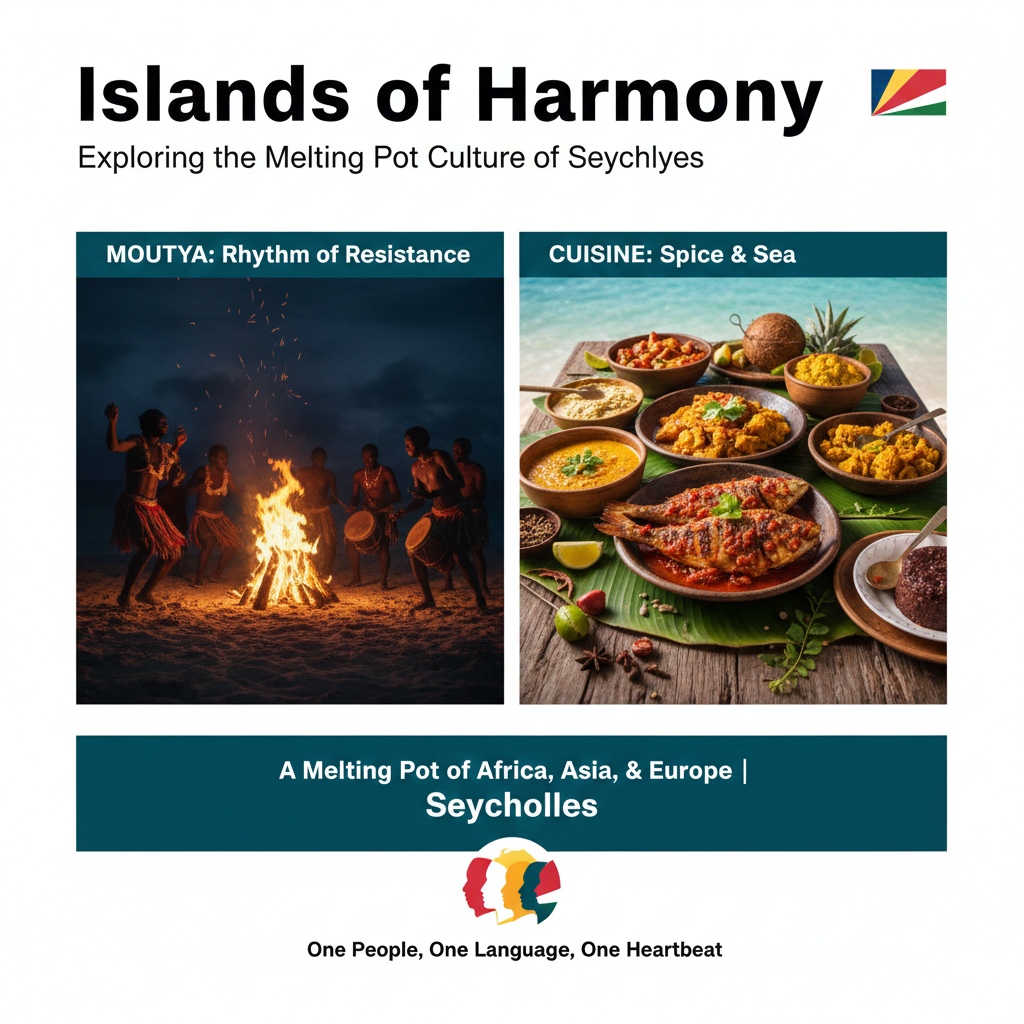
Our expansive journey through Africa’s diverse cultures takes us off the mainland once again, dropping anchor in the turquoise waters of the Indian Ocean to explore Seychelles. Unlike the ancient tribal histories we’ve encountered elsewhere, Seychelles offers a different narrative: a nation with no indigenous population prior to European settlement in the 18th century.1 Here, we delve into the Seychellois Creole culture, a vibrant “melting pot” society forged from the convergence of African, Asian, and European lineages in a remote island paradise.2
Seychelles’ culture is a testament to the creation of a new identity from disparate roots. The ancestors of today’s Seychellois included French settlers, enslaved East Africans and Malagasy people, British colonizers, and later, merchants from India and China.3 Over nearly three centuries of isolation, these groups blended to create a harmonious and distinct Creole nation (Scarr, 2000).
A Nation Born of Convergence
The Seychellois people generally do not define themselves by separate ethnic tribes but rather by their shared Creole identity.4 This unity is visible in the physical diversity of the population and the seamless integration of cultural practices.
- The Origins: The foundation of the population was laid by French planters and the enslaved Africans (primarily from Mozambique and Madagascar) they brought to work the spice and coconut plantations. This was later layered with British administrative influence and the arrival of Indian and Chinese traders.
- A Matriarchal Tendency: Unusually for the region, Seychellois society has historically exhibited strong matriarchal tendencies.5 In the traditional family structure, women often hold the central role in managing the household and finances, a legacy of the plantation era social dynamics (Benedict, 1966).6
Seselwa: The Language of Unity
The most powerful unifying force in the archipelago is the Seychellois Creole language (Seselwa).
- A Unique Voice: While English and French are also official languages, Seselwa is the mother tongue of nearly the entire population.7 It is a French-based creole with a syntax and vocabulary deeply influenced by Bantu languages and Malagasy.
- Literary Pride: Seychelles is one of the few nations to have formalized its Creole language, using it in schools, media, and government, thereby elevating it from a “patois” to a symbol of national pride.8
Moutya and Sega: Rhythms of Resistance and Joy
The heartbeat of Seychellois culture is found in its music and dance, which serve as the strongest link to its African heritage.9
- The Moutya: Recently inscribed on the UNESCO Intangible Cultural Heritage list, the Moutya is a dance of profound historical significance.10 Originating in the days of slavery, it was a nocturnal dance performed around a bonfire. It was a moment of freedom where enslaved people could express their suffering and mock their masters through improvised lyrics. The rhythmic beat is provided by large goatskin drums, heated over the fire to tune them .
- The Sega: While the Moutya is slow and intense, the Sega is the dance of joy. Shared with neighboring Mauritius and Réunion, the Seychellois version is characterized by hip-swaying movements and the shuffling of feet—said to mimic the movement of enslaved people shuffling through the sand while shackled.
A Cuisine of Spice and Sea
Seychellois culture is also expressed through its Creole cuisine, a literal fusion of its history.11 It combines the subtleties of French cooking with the fieriness of Indian curries and the piquancy of Chinese stir-fries, all utilizing local seafood and tropical fruits.12 Dishes like grilled fish with Creole sauce, shark chutney, and ladob (a dessert of banana or sweet potato in coconut milk) tell the story of the islands’ resources and trade connections.13
A Blueprint for Harmony
Seychelles stands as a unique example of a multi-ethnic society that has forged a singular, cohesive identity. It is a culture where a Catholic mass might be followed by a Moutya dance, and where curry is eaten with French-style baguette, illustrating how diverse origins can blend into a harmonious whole.
Our next article will return to West Africa, taking us to Sierra Leone, where we will explore the traditions of the Mende people, known for their female Sande society, and the Temne people.
References:
- Benedict, B. (1966). People of the Seychelles. H.M.S.O.
- Bouchereau, A., & Gane, J. (2018). Seychelles: The Creole Spirit. Silva.
- Scarr, D. (2000). Seychelles Since 1770: History of a Slave and Post-Slavery Society. Africa World Press.


