Islands of Ancestors and Kingdoms: Exploring the Diverse Cultures of Madagascar’s Merina and Sakalava Peoples
By Kwadwo Afrifa – November 14, 2025 13:00
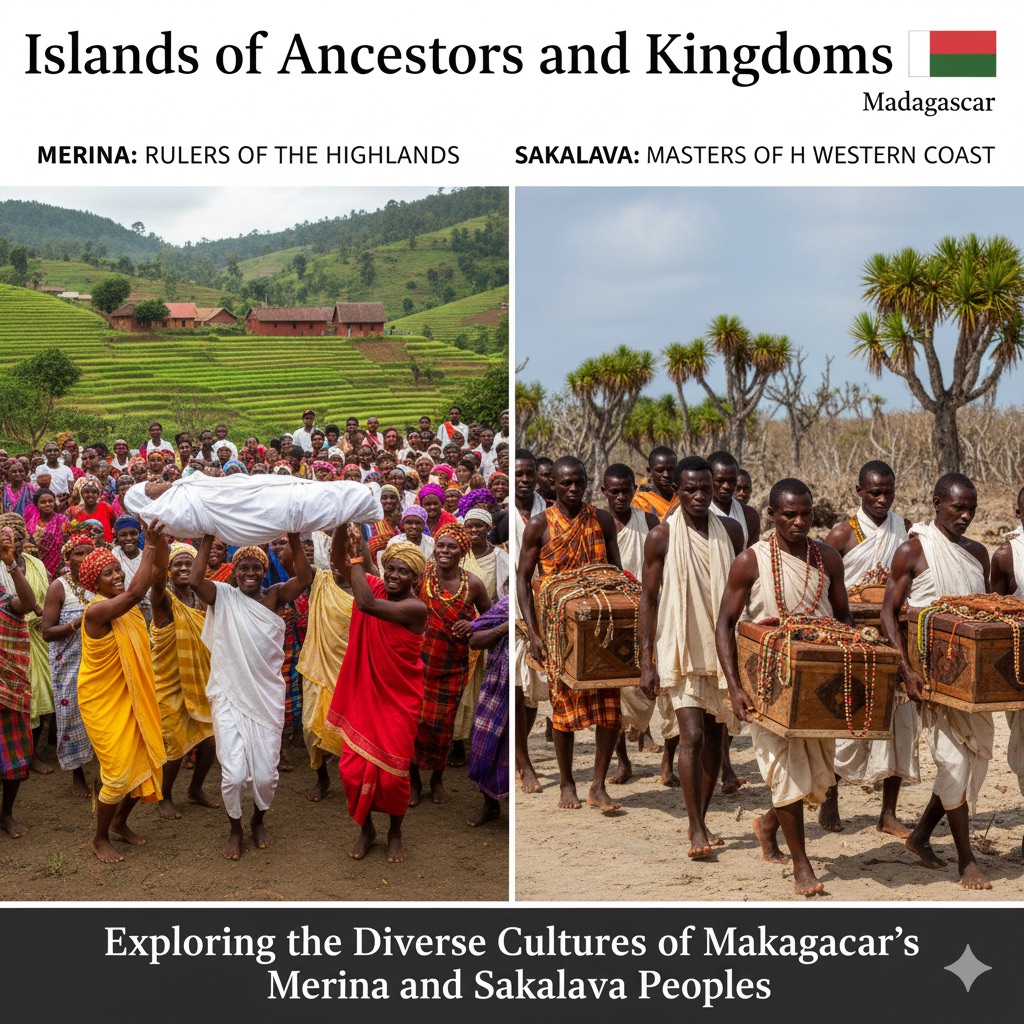
This image contrasts the distinctive cultural practices of Madagascar’s Merina and Sakalava peoples. On the left, Merina people joyously participate in the Famadíhana (Turning of the Bones) ceremony amidst their terraced rice paddies, highlighting their veneration of ancestors in the highlands. On the right, Sakalava men carry ornate royal relics through an arid coastal landscape, symbolizing their devotion to deceased kings and their mastery of the western coast. Titled ‘Islands of Ancestors and Kingdoms | Madagascar,’ this visual beautifully captures the diverse and profound traditions explored in the article.
Our expansive journey through Africa’s diverse cultures now leads us to Madagascar, the world’s fourth-largest island, a place of extraordinary biodiversity and a unique cultural blend of Southeast Asian and East African influences. Here, we delve into the distinct traditions of the Merina people, the dominant group of the central high plateau, and the Sakalava people, whose historical kingdoms spanned the western coast. Their separate histories, social structures, and spiritual practices illustrate the profound diversity of the Malagasy identity.
Madagascar’s original settlement involved successive waves of Austronesian migrants arriving from Borneo around the 1st millennium CE, followed later by Bantu speakers from mainland Africa. This unique blend of origins forms the foundation of all Malagasy culture and the unified Malagasy language (Hurles, 2005).
The Merina: Rulers of the Highlands and Builders of Empires
The Merina people are concentrated in the central high plateau, around the capital city of Antananarivo. Their history is defined by the powerful Merina Kingdom, which successfully unified and ruled most of the island before the French colonization in the late 19th century.
* Social Structure and Hierarchy: Merina society was historically highly stratified, featuring a distinct hierarchy based on lineage, including nobles, commoners, and a historical artisan/slave class. This structure, though modernized, continues to influence social dynamics in the highlands.
* Cultivation and Terracing: The Merina are master rice cultivators, practicing sophisticated terracing and irrigation techniques that transform the central highlands into dramatic landscapes of paddies. Rice is the cornerstone of their economy and diet.
* Famadíhana (Turning of the Bones): The Merina are famous for the Famadíhana, or “Turning of the Bones,” ceremony. This is a joyous ritual where deceased ancestors are exhumed, their shrouds are replaced, and they are wrapped in new silk. The family dances with the remains before returning them to the tomb. This ritual underscores the paramount importance of ancestors (razana) and the belief that they are active participants in the lives of the living (Bloch, 1986).
* Austronesian Linguistic Link: The Merina dialect is considered one of the closest to the original Austronesian language spoken by the earliest settlers.
The Sakalava: Masters of the Western Coast and Royal Relics
The Sakalava people inhabit a vast, arid stretch of the western coast of Madagascar. Their history is defined by the establishment of several powerful Sakalava Kingdoms that controlled important cattle and trade routes from the 17th to the 19th centuries.
* Coastal and Pastoral Livelihoods: The Sakalava’s environment dictates their livelihood, which combines cattle herding (pastoralism) on the coastal plains with fishing along the Mozambique Channel. Their cultural practices reflect a strong connection to both the land and the sea.
* Fitampoha (Washing of the Kings): The most sacred Sakalava ritual is the Fitampoha, the ceremonial Washing of the Royal Relics. The Sakalava maintain an intense focus on the preservation and veneration of the bones and relics of their deceased kings. These relics are believed to be imbued with powerful spiritual essence (hasina) and are the focus of annual pilgrimages and purification rites (Feeley-Harnik, 1991).
* Tromba Possession: The Tromba cult is highly significant among the Sakalava. This practice involves a form of spirit possession where the spirits of dead Sakalava royalty return to possess living mediums. This acts as a mechanism for healing, social commentary, and maintaining the link between the living community and its royal ancestors.
A Unified Island, A Diverse People
Despite their geographical and historical differences—the Merina focusing on the elaborate rites for all ancestors in the highlands, and the Sakalava focusing on the sacred relics and spirits of royal ancestors on the coast—both groups share the fundamental Malagasy values of ancestral veneration (razana), respect for tradition (fomba), and community cohesion.
The Merina, with their impressive agricultural systems and the poignant Famadíhana, and the Sakalava, with their vast kingdoms and the sacred power of the Fitampoha, collectively illustrate the extraordinary cultural depth and blended origins of the Malagasy identity.
Our next article will take us to Malawi, where we will explore the traditions of the Chewa (Chêwa) people, known for their powerful Nyau secret society and masked dances, and the Lomwe people.
References:
* Bloch, M. (1986). From Blessing to Violence: History and Ideology in the Circumcision Ritual of the Merina of Madagascar. Cambridge University Press.
* Feeley-Harnik, G. (1991). A Green Estate: Restoring Independence in Madagascar. Smithsonian Institution Press.
* Hurles, M. E. (2005). “The Dual Origin of the Malagasy in an Archipelago Setting.” American Journal of Human Genetics, 76(5), pp. 894-901.


