House of Stone, Voice of the Ancestors: Exploring the Shona and Ndebele Cultures of Zimbabwe
By Kwadwo Afrifa – December 11, 2025 21:00
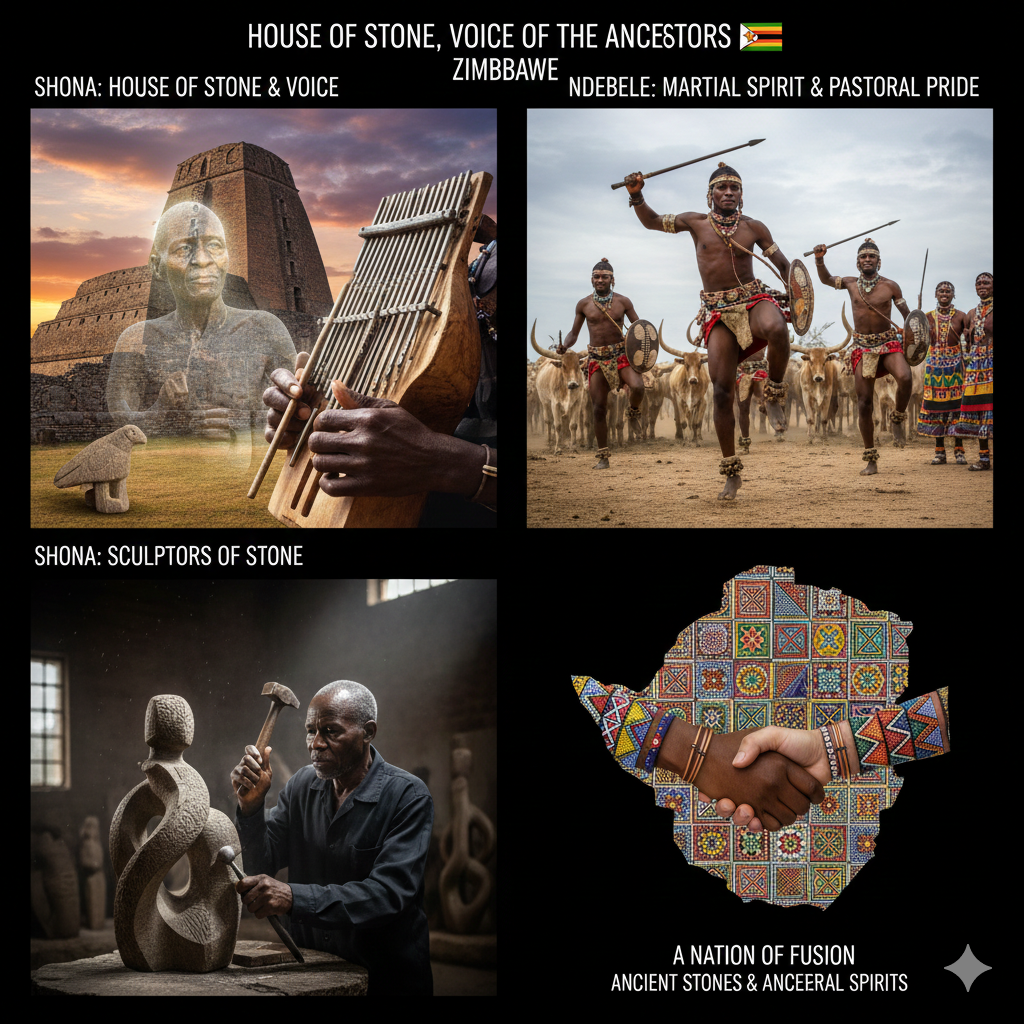
Our expansive journey through Africa’s diverse cultures reaches its final destination on the continent, arriving in Zimbabwe. The country’s very name, derived from the Shona term dzimba dza mabwe (“Great Houses of Stone”), pays homage to a legacy of civilization that predates colonial history.1 Here, between the Limpopo and Zambezi rivers, we explore the ancient, spiritual traditions of the Shona people and the martial, pastoral heritage of the Ndebele people.
Zimbabwe’s cultural identity is anchored in the physical permanence of its ancient stone cities and the ephemeral, spiritual beauty of its music, creating a society that honors both the seen and the unseen worlds.
The Shona: Builders of History and Players of the Mbira
The Shona people (a collective term for groups including the Zezuru, Karanga, Manyika, and Korekore) constitute the majority of the population. They are the architects of the Great Zimbabwe civilization (11th–15th centuries), the largest pre-colonial stone structure in sub-Saharan Africa.2
- Great Zimbabwe: This ruined city is the soul of the nation. Built without mortar, its massive granite walls and conical towers stand as a testament to a highly organized society that traded gold and ivory with the Indian Ocean coast.3 It represents the permanence of Shona ancestry and governance.
- The Mbira (Thumb Piano): If Great Zimbabwe is the body of the culture, the Mbira is its voice.4
- Mbira dza Vadzimu: Specifically the “Mbira of the Ancestors,” this instrument consists of 22 to 28 metal keys mounted on a hardwood soundboard (often placed inside a gourd resonator).
- The Bira Ceremony: The Mbira is not just an instrument; it is a telephone to the spirit world.5 During a Bira ceremony, the interlocking, cyclical rhythms of the Mbira are played to induce a trance state in spirit mediums (svikiro), allowing them to become possessed by ancestral spirits (vadzimu) to offer guidance on drought, illness, or social disputes (Berliner, 1978).6
- Stone Sculpture: In the 20th century, a globally acclaimed Shona Sculpture movement emerged.7 Modern artists, channeling the spirit of their ancestors, carve serpentine and verdite stone into abstract, emotive forms, often depicting spirits or family bonds.8
The Ndebele: The Northern Zulus
In the southwest of the country (Matabeleland), live the Ndebele people. Their presence in Zimbabwe is the result of the Mfecane (the great scattering) in the 19th century, when the general Mzilikazi fled the rule of Shaka Zulu to establish his own kingdom, the Mthwakazi, in present-day Zimbabwe.
- A Martial Legacy: The Ndebele share a linguistic and cultural lineage with the Zulus of South Africa. Historically, their society was organized into military regiments (amabutho), and their identity was forged in conquest and cattle raiding. This martial pride is still evident in their traditional dances, such as the Indlamu, a high-kicking war dance that demonstrates physical strength and discipline.
- Cattle Culture: Like the Maasai and Zulu, the Ndebele are a cattle-centered society. A man’s wealth and social standing are measured by his herd. Cattle are essential for lobola (bridewealth) and for connecting with the ancestors through sacrifice.9
- Visual Arts: While their cousins in South Africa are famous for geometric house painting, the Zimbabwean Ndebele are renowned for their intricate beadwork and fine basketry.10 The ilala palm baskets are woven with complex geometric designs that mirror the patterns found in their beadwork and pottery.
A Synthesis of Spirit
Zimbabwean culture today is a fusion of these powerful legacies. It is a place where the ancient stone birds of Great Zimbabwe appear on the national flag, and where the electric guitars of “Chimurenga music” (created by Thomas Mapfumo) translate the sacred rhythms of the Mbira into songs of political resistance and social commentary.11
This concludes our journey through the sovereign nations of the African continent.
References:
- Berliner, P. (1978). The Soul of Mbira: Music and Traditions of the Shona People of Zimbabwe. University of California Press. (The seminal ethnomusicological text on the Mbira).
- Garlake, P. (1973). Great Zimbabwe.12 Thames & Hudson. (A comprehensive archaeological study of the stone city).
- Rasmussen, R. K. (1978). Migrant Kingdom: Mzilikazi’s Ndebele in South Africa. Collings.13 (Historical context on the origins of the Ndebele state).


