Heirs of a Maritime Kingdom: Exploring the Enduring Legacy of the Kongo People in the Democratic Republic of Congo
By Kwadwo Afrifa – June 16, 2025 06:35pm
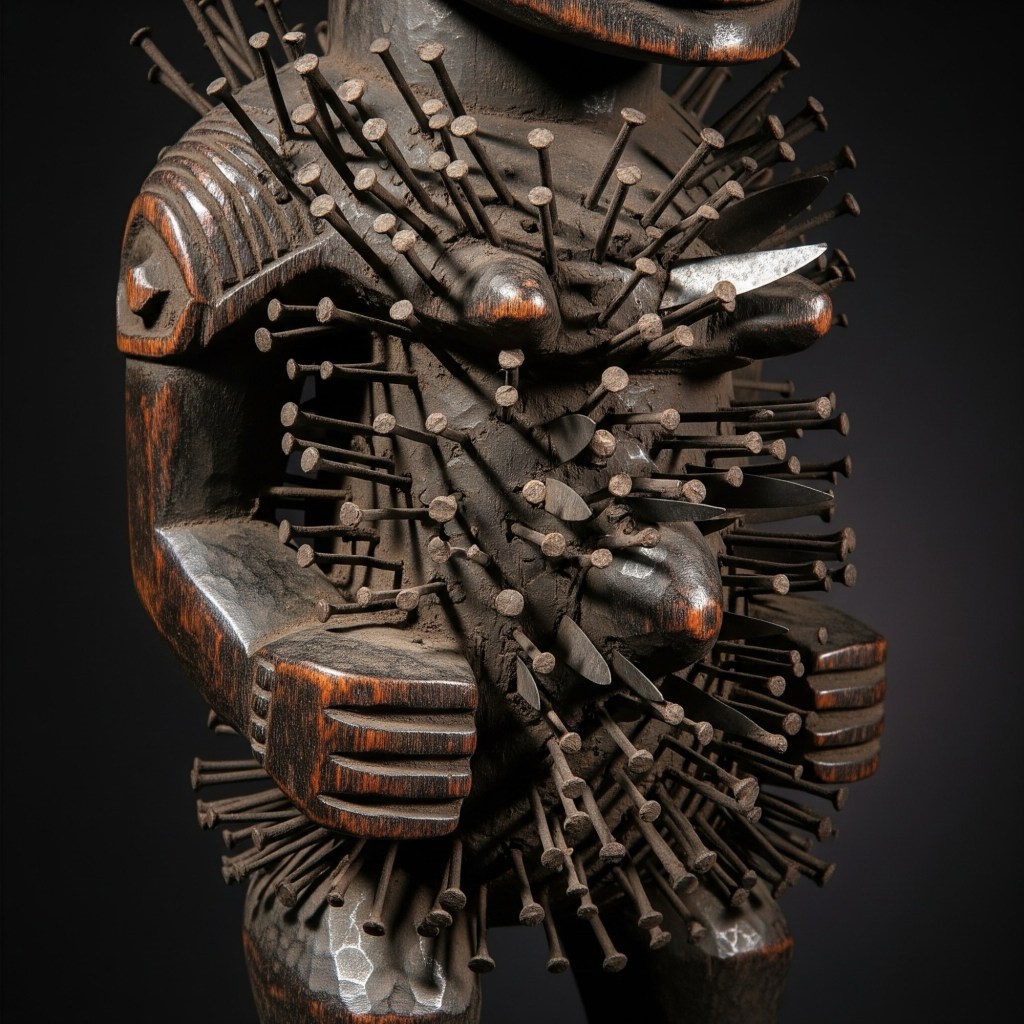
An Nkisi figure, a powerful carved wooden effigy of the Kongo people, adorned with nails and blades. These figures are central to Kongo spiritual beliefs and are activated for healing, protection, and justice.
Our expansive journey through Africa’s diverse cultures now returns to the Democratic Republic of Congo (DRC), a vast nation at the heart of the continent. Here, we delve into the profound historical and cultural legacy of the Kongo people, who represent a significant ethnic group in the western parts of the DRC, and whose influence extends into neighboring Angola (which we previously covered) and the Republic of Congo. The Kongo are heirs to a powerful and sophisticated historical kingdom, renowned for its early interactions with Europe, its unique spiritual beliefs, and its resilient cultural expressions that continue to thrive today.
The Kongo Kingdom (also known as the Kingdom of Kongo) emerged around the 14th century in the lower Congo River region. By the time of the first European contact in the late 15th century, it was a highly organized and influential state with a complex political system, a thriving economy, and a sophisticated cosmology. Its strategic location near the mouth of the Congo River made it a central player in regional trade networks and later, in the trans-Atlantic slave trade, profoundly impacting its trajectory (Thornton, 1983).
A Kingdom of Intertwined Power and Spirituality:
The Kongo Kingdom was characterized by a strong centralized authority under the ManiKongo (king), who ruled over a network of provinces and subordinate chieftaincies. The political structure was deeply intertwined with spiritual beliefs, with the ManiKongo often seen as possessing sacred power and mediating between the living and the ancestral realms. This blend of secular and spiritual authority was a hallmark of Kongo governance (MacGaffey, 1986).
The Spiritual World: Minkisi and Cosmograms:
Kongo spiritual beliefs are rich and complex, centered on the concept of nkisi (plural: minkisi). These are sacred objects or bundles, often containing various substances and imbued with spiritual power, which can be activated by ritual specialists (nganga) for healing, protection, justice, or other purposes. Minkisi are tangible manifestations of the spiritual forces that permeate the universe and are central to Kongo cosmology (MacGaffey, 1993).
The Kongo cosmogram (dikenga) is another crucial element, a cross-shaped symbol with four cardinal points, representing the cycle of life, death, and rebirth, and the intersection of the human and spiritual worlds. This symbol is found in various forms of Kongo art and ritual, embodying their understanding of existence.
Art as Embodied Power and Communication:
Kongo art is renowned for its expressive power and its deep connection to spiritual and social functions. Key artistic forms include:
* Nkisi Figures: These are perhaps the most iconic Kongo art forms. Carved wooden figures, often anthropomorphic, are frequently adorned with nails, blades, or other materials driven into them, symbolizing the activation of their spiritual power for oaths, justice, or protection. Each nkisi figure is unique and created for a specific purpose (MacGaffey, 1993).
* Textiles (Ngola Cloth): The Kongo were skilled weavers, producing elaborate raffia textiles (ngola cloth) used for clothing, currency, and funerary shrouds. These textiles often feature intricate geometric patterns, reflecting aesthetic sophistication and symbolic meaning (Bassani, 1989).
* Funerary Art: The Kongo have a rich tradition of funerary art, including grave markers and effigies, reflecting their reverence for ancestors and their beliefs about the afterlife.
Imagine the compelling presence of a nkisi figure, its surface textured by the nails driven into it, representing a history of communal vows and spiritual interventions.
Language and Oral Traditions:
The Kikongo language (or various dialects of Kikongo) is widely spoken by the Kongo people. Oral traditions, including historical narratives, myths, proverbs, and songs, are vital for transmitting cultural knowledge, legal principles, and social norms across generations. These traditions reinforce group identity and connect the present with the ancient kingdom’s past.
Resilience and Enduring Influence:
Despite the devastating impact of the trans-Atlantic slave trade, the imposition of colonial rule, and the political turmoil of the modern era, the Kongo people have demonstrated remarkable cultural resilience. Their language, spiritual beliefs (often syncretized with Christianity), artistic traditions, and social structures continue to play a significant role in the cultural landscape of the Democratic Republic of Congo, testifying to the enduring legacy of their ancient kingdom.
The Kongo people, with their powerful historical kingdom, their unique spiritual world embodied in minkisi and cosmograms, and their compelling artistic expressions, offer a profound example of a Central African culture that has maintained its distinct identity and vital traditions through centuries of change.
Our next article will take us to the Republic of Congo, where we will explore the artistic traditions, particularly masks and sculptures, and historical kingdoms of the Teke people.
References:
* Bassani, E. (1989). African Art and the Age of Exploration. Center for African Art. (Includes discussion of Kongo textiles and their early interaction with Europe).
* MacGaffey, W. (1986). Religion and Society in Central Africa: The Bakongo of Lower Zaire. University of Chicago Press.
* MacGaffey, W. (1993). Art and Healing of the Bakongo Commented Upon by Themselves: Minkisi from the Laman Collection. Indiana University Press.
* Thornton, J. K. (1983). The Kingdom of Kongo: Civil War and Transition, 1641-1718. University of Wisconsin Press.

