From Forest Guardians to Serene Visages: Exploring the Artistic and Spiritual World of Gabon’s Fang and Punu Peoples
By Kwadwo Afrifa – June 06, 2025 19:00pm
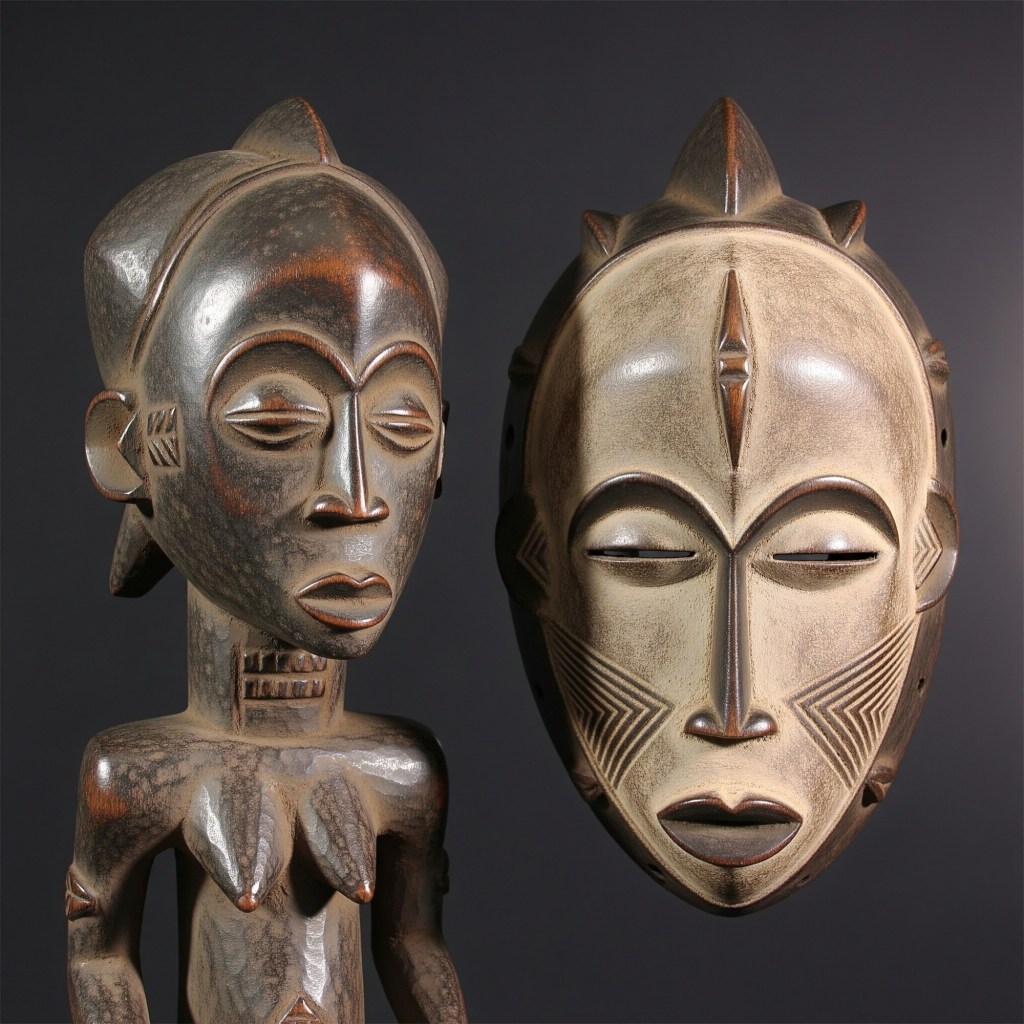
This A.I generated image features a Fang Bieri figure standing alongside a Punu Okuyi mask, offering a powerful visual representation of Gabon’s rich artistic and spiritual heritage. The Fang Bieri, an ancestral guardian figure, showcases the Fang people’s profound connection to their forebears, while the serene, white Punu Okuyi mask, traditionally used in funerary rites, embodies the spiritual realm of ancestors. Together, they highlight the diverse and intricate artistic expressions born from the equatorial rainforests of Central Africa.
Our expansive journey through Africa’s diverse cultures now leads us to Gabon, a nation characterized by its dense equatorial rainforests, rich biodiversity, and a profound artistic heritage. Here, we delve into the traditions of two significant cultural groups: the Fang people, who we’ve previously encountered in Equatorial Guinea, and the distinctive Punu people, celebrated for their serene white masks. Their unique artistic expressions, spiritual beliefs, and adaptations to the forest environment offer a compelling glimpse into the cultural depth of Central Africa.
Gabon’s history has been shaped by its lush environment, abundant resources, and later, by the trans-Atlantic slave trade and European colonialism. Indigenous cultures developed sophisticated ways of living in harmony with the forest, fostering unique spiritual and artistic practices.
The Fang: Continuing the Legacy of Mvet and Bieri
As previously discussed in the context of Equatorial Guinea, the Fang people are a major ethnic group also with a significant presence in Gabon. Their culture continues to be defined by:
* Profound Oral Traditions (Mvet): The Mvet epic, a cornerstone of Fang culture, remains a vital form of storytelling, poetry, and musical performance in Gabon. It serves as a comprehensive repository of Fang history, cosmology, philosophy, and moral instruction, performed by skilled bards who transmit this complex knowledge across generations (Belinga, 1965).
* Ancestral Reliquary Art (Bieri): The iconic Bieri figures are central to Fang spiritual practices in Gabon. These powerful wooden sculptures, guardian figures for ancestral relics contained in bark boxes, embody the spiritual essence of the lineage’s forebears. Their highly stylized, abstract forms, often featuring oversized heads and serene expressions, are not merely aesthetic objects but active participants in rituals, protecting the living and connecting them to the ancestral realm (Perrois, 1985). The widespread influence of Fang Bieri on early 20th-century European modern art is a testament to their artistic power.
* Forest Livelihoods and Secret Societies: Life for many Fang traditionally revolved around the rainforest, combining shifting cultivation with hunting and gathering. Various secret societies continue to play roles in male initiation, social control, and the transmission of esoteric knowledge.
The Punu: The Enigma of White Masks and Initiation
The Punu people are a Bantu-speaking group primarily inhabiting southern Gabon. They are celebrated worldwide for their distinctive and aesthetically captivating masks, which are deeply embedded in their spiritual and social life.
* White Masks of Serenity (Okuyi): The most famous Punu artistic creations are their stunning white masks, known as Okuyi (or Mukudj). These masks are characterized by their naturalistic facial features, often with high-domed foreheads, scarification marks (diamond shapes on the forehead), and serene, downcast eyes. They are typically painted with white kaolin clay, symbolizing the realm of ancestors and spirits. The masks are traditionally worn by male dancers on stilts during funeral ceremonies and other significant community events (Chaffin, 1979).
* Funerary and Initiation Rituals: The Okuyi masks are integral to Punu funerary rites, believed to embody female ancestors who return from the afterlife to guide the deceased and comfort the living. These performances are deeply spiritual and physically demanding. While the specific details are often guarded by initiation societies, the dances performed with Okuyi masks are crucial for connecting the community with the ancestral world (Perrois & Chaffin, 1988).
* Figurative Sculptures: Beyond masks, Punu artists also carve figurative sculptures, often depicting female ancestors, that are used in divination and healing rituals, embodying spiritual power and protective qualities.
* Matrilineal Society: Punu society is traditionally matrilineal, meaning descent and inheritance are traced through the mother’s line. This system influences social organization, property ownership, and the role of women within the community.
Cultural Resilience in a Resource-Rich Nation
Both the Fang and Punu, like other Gabonese communities, navigate the complexities of a modern, resource-rich nation. While traditional practices may adapt to contemporary life, there is a strong emphasis on preserving their unique languages, artistic heritage, and spiritual knowledge. Gabon’s cultural diversity, exemplified by these two groups, forms a vital part of its national identity.
The Fang, with their profound oral epics and ancestral guardian figures, and the Punu, with their enigmatic white masks and deep spiritual connection to ancestors, collectively contribute to the extraordinary artistic and cultural landscape of Gabon. Their traditions highlight the rich tapestry of beliefs and expressions found within the equatorial forests of Central Africa.
Our next journey will take us to The Gambia, where we will explore the traditions of the Mandinka people, known for their rich oral tradition (griots/jali), and the Fulani people, again, with their pastoralist lifestyles.
References:
* Belinga, E. (1965). L’épopée du Mvet: Mbèga. Présence Africaine.
* Chaffin, A. (1979). The Punu Style: An Essay on Gabonese Sculpture. R. & F. Chaffin.
* Perrois, L. (1985). Arts du Gabon: Les cultures et les techniques de l’art. Nathan.
* Perrois, L., & Chaffin, A. (1988). L’art Fang. Éditions des Musées Nationaux. (Discusses both Fang and Punu art, often compared due to regional proximity and shared influences).


